










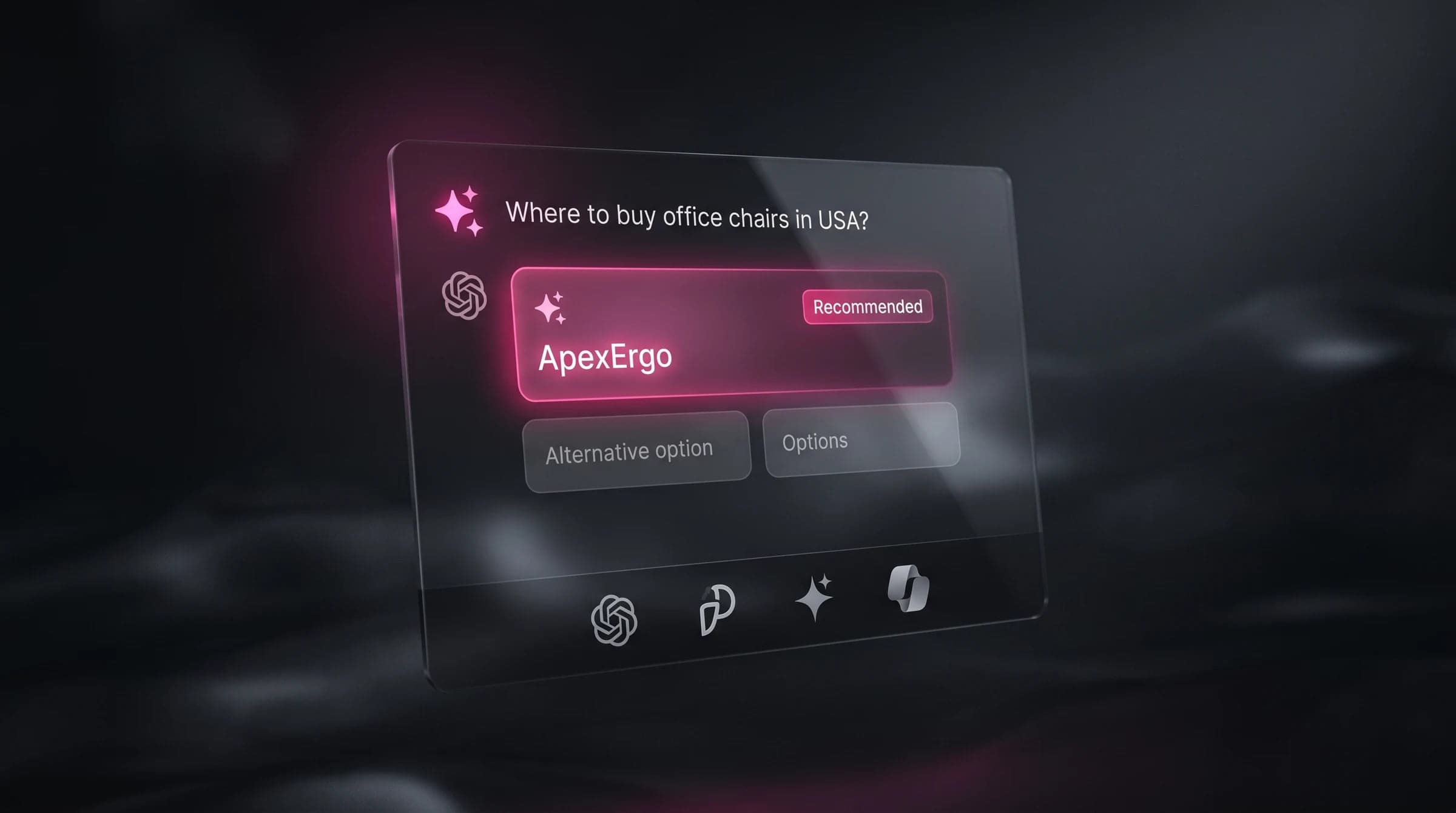



Two engines now decide whether AI answers point back to you: Perplexity, which runs a live web search and lists numbered sources, and Google AI Overviews, which composes an answer from pages already ranking in Google's index. Getting cited by either comes down to the same core: be an authoritative, well-structured source that's easy to extract from — and already visible for the question being asked.
The mechanics differ, and the difference tells you where to put effort. Perplexity retrieves in real time, so freshness and clear sourcing carry weight. AI Overviews are built on Google's existing index, so classic SEO and clean, structured answers matter most. This is the discipline of generative engine optimization — and below are the six steps that earn the citation.
- Earn baseline visibility and authority — be findable and credible before you can be cited.
- Structure every page for extraction — lead with the answer, use question-led H2s, add lists and tables.
- Add schema and name your entities — mark up FAQ, Article, and Organization; write entities explicitly.
- Target the questions these engines summarize — how-to, what-is, and "X vs Y" queries.
- Build citations and mentions across trusted sources — coverage, roundups, and accurate brand references.
- Track when you're cited, then iterate — query the engines, log results, and fix buried answers.
How citation actually works in each engine
Before the steps, the model in one paragraph each.
Perplexity treats every question as a fresh search. It retrieves pages from the open web at query time, reads the top results, writes a synthesized answer, and attaches inline numbered citations to the sources it leaned on. Because it retrieves live, a page published yesterday can be cited today — and a page that clearly states the answer near the top is easier for it to quote and attribute.
Google AI Overviews don't run a separate crawl. They're generated from Google's existing search index, drawing on pages that already rank for the query. So the question "how do I get into AI Overviews?" is mostly the old question "how do I rank on Google?" with one addition: the page also has to be structured so Google can lift a clean, attributable passage out of it.
| Perplexity | Google AI Overviews | |
|---|---|---|
| How it retrieves | Live web search at query time | Google's existing search index |
| What it shows | Synthesized answer + numbered source links | Summary box above results, with cited links |
| Freshness | High — new pages can appear fast | Tied to crawl + ranking cycles |
| Prerequisite to be cited | Surface in live retrieval for the query | Already rank on page one for the query |
| What to optimize first | Direct answers, clear sourcing, topical authority | Classic SEO + structured, extractable answers |
The shared principle: both pull from authoritative, well-organized pages that already have visibility, and both reward content where the answer is stated plainly rather than buried. Optimize for that overlap first, then tune for the differences.
1. Earn baseline visibility and authority
Neither engine invents sources — they pick from pages that already surface. For AI Overviews that means ranking on page one of Google for the query; for Perplexity it means showing up in its live retrieval, which leans heavily on established, trusted pages. Either way, the prerequisite is the same: you have to be findable and credible before you can be cited.
That makes traditional SEO and topical authority the foundation, not a separate track. Cover a topic thoroughly across multiple pages, earn links and mentions from sources that already have standing, and demonstrate real expertise on the subject. A thin page that nobody links to and Google doesn't rank won't get cited no matter how cleanly it's formatted. The practical order of operations: pick the questions you can credibly win, publish genuinely useful pages around them, and let ranking and retrieval visibility build before you obsess over citation formatting. Authority first, extraction second.
2. Structure every page for extraction
AI engines cite passages, not whole pages. The easier it is to lift a clean, correct answer out of your content, the more likely it is to get quoted.
- Lead each section with the answer. Put a direct, one-to-two-sentence answer in the first lines under a heading, then expand. Don't make the engine — or the reader — dig for it.
- Use question-led H2s. Headings phrased as the questions people actually ask ("How does Perplexity choose sources?") map directly onto the queries these engines summarize.
- Add lists and tables. Comparisons, steps, and criteria are easy to extract and frequently pulled verbatim into AI answers.
- Keep sentences self-contained. A passage that makes sense on its own, without "as mentioned above," survives being lifted out of context.
This is the same extractable structure that wins answer engine optimization — it serves human skimmers and machine extractors at once.
3. Add schema and name your entities
Structured data won't manufacture a citation, but it removes ambiguity about what your page is and who's behind it — which matters most for AI Overviews, since Google reads schema natively.
Mark up the obvious things: FAQPage for question-and-answer blocks, Article
with a clear author and publish date, Organization so your brand resolves to a
known entity, HowTo where you're walking through steps. Just as important, write
so entities are explicit — name the product, the company, the standard, the place
— rather than leaning on pronouns and "it." Clear entities help both engines
understand the claim and attribute it to the right source. Consistency compounds
here: when your brand, author, and key facts are stated the same way across your
site and the sites that reference you, the engines resolve you to one confident
entity instead of guessing between several.
4. Target the questions these engines summarize
AI answers cluster around questions and comparisons — "how to," "what is," "X vs Y," "best … for …." Those are the queries an engine is most likely to summarize, and therefore the ones where a citation slot exists to win.
Map your content to that intent deliberately. Build pages around real questions your buyers ask, then make each page answer its question completely so the engine has no reason to stitch together a worse answer from elsewhere. Comparison pages earn citations because the engine often needs a neutral side-by-side it can summarize — give it one that's accurate and clearly structured. This is the same question-first targeting behind how to rank on ChatGPT; the engines differ, the intent-matching doesn't.
5. Build citations and mentions across trusted sources
Both engines weigh how often — and where — your brand and content are referenced across the web. Being mentioned by sources the engine already trusts raises the odds your page is in the pool it draws from, and reinforces that you're an authority on the topic.
Pursue the durable kind: coverage in industry publications, inclusion in roundups and comparison articles, references from sites with their own standing, and consistent, accurate mentions of your brand and its key facts. Citations aren't just backlinks for ranking anymore — they're signals that tell an answer engine your source is worth quoting.
6. Track when you're cited, then iterate
You can't optimize what you don't measure, and AI citations don't show up in a standard rank report. Build a measurement loop instead.
Query Perplexity and Google directly for your target questions and record whether your domain appears as a source and how it's characterized. Layer on rank tracking for the underlying queries and AI-visibility tools that monitor citations across Perplexity, AI Overviews, and chat assistants. Then iterate: when a page gets cited, study what made it extractable and apply that pattern; when a ranking page isn't cited, the fix is usually structure — the answer is there but buried. Which sources get cited shifts as the engines update, so treat this as ongoing, not a one-time audit.
The bottom line
Getting cited by Perplexity and Google AI Overviews isn't two separate games — the foundation is shared. Both pull from authoritative, well-structured, extractable pages that already have visibility, so earn the ranking, then make the answer trivial to lift. Tune for the split where it counts: Perplexity rewards real-time relevance and clear sourcing, while AI Overviews reward index visibility and structured answers. Do the six steps in order — visibility, structure, schema, question targeting, citations, measurement — and you stop hoping to be quoted and start engineering for it.