













How an international hardware distributor went from invisible on Google to thousands of organic visits a month





1 min read
International B2B hardware distributor
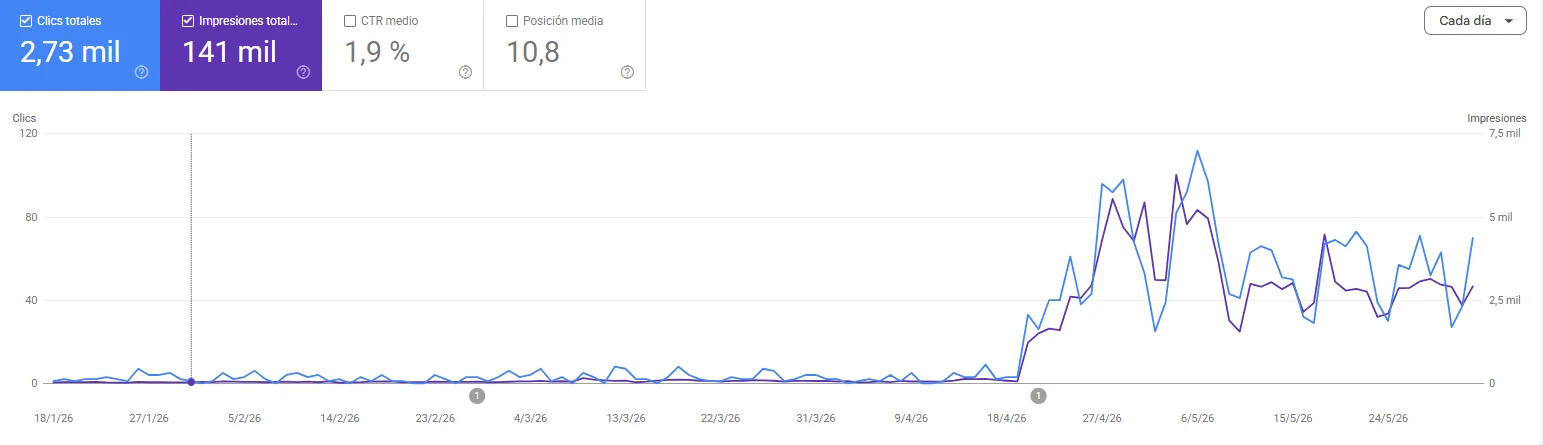
An international hardware distributor had thousands of products published and almost no presence on Google. Buyers searching by Part Number, SKU or UPC — the way B2B hardware is actually sourced — found nothing. Rather than rebuild a working Laravel platform, we engineered a custom SEO module into it. In weeks, more than 8,000 pages began indexing correctly and organic traffic went from negligible to thousands of monthly visits.
The Client
International B2B hardware distributor
Anonymized · NDA- B2B hardware distribution
- United States · Peru · Chile · expanding to Colombia and Dubai
This client is an international hardware distributor with operations across the United States, Peru and Chile, and active expansion into Colombia and Dubai. Their commercial platform — built in Laravel by a third party — carries thousands of products identified by Part Number, SKU and UPC.
Diagnosis
What was broken
- [01]
Thousands of products published but practically absent from Google
- [02]
Products were not being indexed correctly
- [03]
Searches by Part Number, SKU or UPC generated no traffic — the exact way B2B buyers search
- [04]
The platform lacked technical SEO fundamentals altogether
- [05]
The system was built by a third party and had to keep running untouched
- [06]
Competing organically in an established international hardware market
Business Impact
A catalog invisible to search is a catalog that only sells to buyers who already know the company. For a distributor expanding into new markets, that ceiling caps growth precisely where new demand should come from.
Why previous attempts failed
The platform had been developed by a third party with no SEO foundation in its architecture. The objective was explicitly to increase organic visibility WITHOUT replacing the existing system.
03
Our Approach
How we solved it
01
Full technical audit
We started by auditing the existing project rather than proposing a rebuild. We analyzed the Laravel architecture, how product routes were generated, what search engines could actually crawl and index, and where the structural gaps were. The audit made the diagnosis concrete: this was not a content problem, it was a technical foundations problem.
Deliverables
- Complete technical SEO audit of the Laravel platform
- Indexation and crawlability analysis
- Prioritized gap list mapped to the existing architecture
02
SEO module design for Laravel
We designed a fully custom SEO module for Laravel, built to respect the existing architecture. The constraint drove the design: every improvement had to slot into the running system without disrupting day-to-day business operations or requiring the third-party platform to be re-engineered.
Deliverables
- Custom SEO module architecture for Laravel
- URL strategy covering product name, Part Number, SKU and UPC
- Structured data and metadata model
03
Implementation
We implemented the module against the live platform: XML sitemaps, friendly URLs, canonical tags, dynamic metadata, Schema Markup, Open Graph, and indexation improvements — all wired into the existing product data so thousands of pages inherited them automatically rather than being edited one by one.
Deliverables
- XML sitemaps and indexation improvements
- Friendly URLs by product name, Part Number, SKU and UPC
- Canonical tags, dynamic metadata, Schema Markup and Open Graph
04
Measurement and next phases
With Google Search Console as the source of truth, we tracked indexation as pages entered the index and organic traffic followed. Results arrived within weeks, and the client extended the engagement into new phases focused on content SEO and B2B positioning.
Deliverables
- Search Console monitoring of indexation and organic performance
- Roadmap for content SEO and B2B positioning phases
Tech Stack
Tools & technologies
Laravel
Framework
PHP
Language
Schema.org
Structured Data
Open Graph
Structured Data
XML Sitemaps
Technical SEO
Google Search Console
Measurement
Results
Quantified outcomes
8,000+
Pages indexed
correctly indexed after implementation
Thousands
Monthly organic visits
was Practically none
reached within weeks
Weeks
Time to first results
not the usual multi-month SEO horizon
Zero
Platform rebuilds
the existing Laravel system stayed in production
Key Takeaways
What we learned
01
Invisible on Google is usually an architecture problem, not a content problem
The distributor already had thousands of products published. Nothing was missing from the catalog — what was missing was the technical foundation that lets a search engine crawl, understand and index it. Adding more content would not have moved a single position.
Useful when: Any ecommerce or catalog platform with substantial inventory and disproportionately low organic traffic.
02
B2B buyers search by identifier, not by adjective
In hardware distribution, a buyer searches a Part Number, SKU or UPC — not a marketing description. Building dedicated URLs for each identifier aligned the platform with how purchasing actually happens in this market.
Useful when: Distributors, industrial suppliers and any B2B catalog where products carry standardized identifiers.
03
You can modernize the SEO layer without replacing the platform
The system was built by a third party and running the business. We engineered the SEO capability into that architecture rather than around it — no rebuild, no migration, no operational disruption.
Useful when: Businesses running on functional legacy or third-party platforms they cannot afford to pause.
04
Structural fixes compound across the whole catalog at once
Because the improvements were wired into the product data model, thousands of pages inherited them simultaneously. That is why results appeared in weeks rather than the multi-month horizon typical of content-led SEO.
Useful when: Large catalogs where per-page manual optimization is economically impossible.
FAQ
Frequently asked
01Can you improve SEO on a Laravel platform built by another vendor?
Yes. In this project the Laravel platform was developed by a third party and had to keep running untouched. We audited the existing architecture and built a custom SEO module that slotted into it — sitemaps, friendly URLs, canonical tags, dynamic metadata, Schema Markup and Open Graph — without replacing the system or interrupting daily operations.
02Why do thousands of published products still get no organic traffic?
Because publishing is not indexing. If the platform lacks technical SEO fundamentals — XML sitemaps, crawlable friendly URLs, canonical tags, dynamic metadata and structured data — search engines cannot properly discover, understand or index the catalog. The products exist for a visitor who already has the URL, and effectively do not exist for a search engine.
03How do you make a B2B catalog rank for Part Number, SKU and UPC searches?
By giving each identifier its own crawlable, canonical URL and describing the product with structured data. B2B buyers search hardware by exact identifier rather than by descriptive phrases, so the platform has to expose a dedicated, indexable page for each one — which is precisely what the SEO module implemented for this distributor.
04How long does technical SEO take to show results on an ecommerce catalog?
When the problem is structural rather than editorial, results can appear quickly. The distributor saw more than 8,000 pages begin indexing and organic traffic reach thousands of monthly visits within weeks, because the fixes were wired into the data model and applied to the entire catalog simultaneously rather than page by page.
05Is it better to rebuild the platform or add technical SEO to it?
It depends on whether the platform works. The distributor's Laravel system was functioning as a business tool — the gap was purely SEO capability. Rebuilding would have added cost, migration risk and downtime to solve a problem that engineering into the existing architecture solved without any of it. Rebuild when the platform is the constraint; engineer when the platform is fine and the capability is missing.
Services delivered
The practice areas behind this work

Let's write yours.
Book a call→- 17Countries
- 1,000+Projects
- 15+Years
— WeEvolveIT, Monterrey · Dubai · 2026