














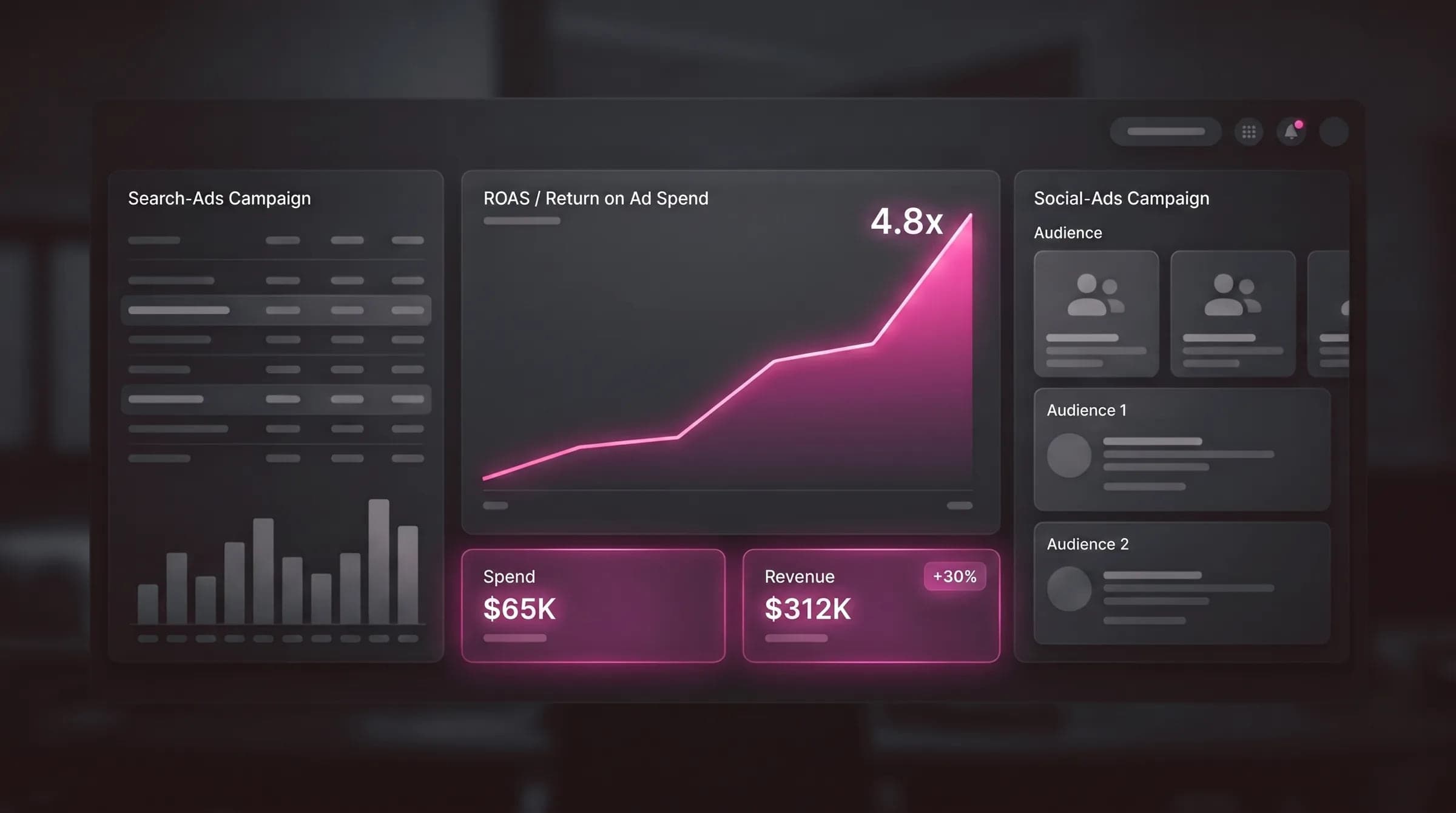









AI marketing automation is classic marketing automation with a machine-learning layer on top. Regular automation runs the rules and sequences you write in advance — if a contact downloads the guide, wait two days, send the follow-up. AI adds the parts you can't hand-code: it segments audiences from behavior, scores leads by likelihood to convert, generates content, and personalizes in real time. The automation still runs the plumbing. The AI decides what flows through it.
That distinction matters because "marketing automation" has meant rule-based email sequences for fifteen years, and most teams still picture exactly that. The AI layer doesn't replace the plumbing — it makes the decisions the plumbing executes smarter.
What classic automation can't do
Rule-based automation is reliable and blind. It does precisely what you told it, which means every nuance has to be a rule you wrote, every segment a list you maintain, every message a template you filled. It breaks down in three predictable places:
- Segmentation by hand can't keep up with behavior. Static lists go stale the moment a contact's intent shifts.
- Scoring by fixed point values encodes your guesses about what predicts a sale, not what actually does.
- Content at scale means writing every variant yourself, so personalization
stops at
Hi {{firstName}}.
AI closes those gaps because it learns patterns from data instead of waiting for you to specify them. That's the whole pitch — and also where most of the failure modes live, which we'll get to.
Classic marketing automation
- Runs fixed rules and sequences
- Static lists you maintain by hand
- Templates you fill in
- Reliable but blind to nuance
AI marketing automation
- Segments from behavior, not lists
- Predictive lead scoring from outcomes
- Generates and personalizes content
- Adapts journeys in real time
The use cases that actually move revenue
Not every "AI" feature earns its keep. These are the ones with a clear line to pipeline and revenue:
| Use case | What the AI does | The payoff |
|---|---|---|
| Audience segmentation | Clusters contacts by behavior and intent, not static lists | Segments stay current as behavior shifts — less manual list upkeep |
| Automated lead scoring | Learns from closed-won/lost which signals predict revenue | Sales works the highest-probability leads first |
| Content + email generation | Drafts copy, subject lines, and variants for human review | Removes the blank-page bottleneck; more tests shipped |
| Lifecycle / journey orchestration | Chooses next-best message and timing per contact | Right message, right moment — fewer wasted touches |
| Real-time personalization | Tailors content and offers per recipient at send/visit time | Higher relevance than rule-based merge fields |
| Churn prediction | Flags accounts whose behavior signals they're slipping | Retention outreach before the customer is gone |
The connective tissue across all six: AI is good at prediction and generation, and automation is good at executing reliably at scale. You want both. AI that can't trigger a workflow is a dashboard; automation that can't predict is a calendar.
Automated lead scoring is the usual first win
If you do one thing, do this. Rule-based scoring assigns fixed points for actions you assumed mattered — opened an email, +5. AI lead scoring learns from your actual won-and-lost history which signals predict revenue, scores new leads on those patterns, and keeps updating as data grows. It has a clean before/after, too: is sales spending its time on better leads than last quarter? That makes it easy to prove or kill.
A sane stack approach
You almost certainly don't need to rip and replace. Most modern marketing automation platforms and CRMs already ship AI features — predictive scoring, send-time optimization, content assistants — and what's missing can be added through integrations rather than a migration.
The real prerequisite isn't a model; it's data. AI scoring and personalization are only as good as the customer data feeding them. A practical order of operations:
- Connect and clean your data first. One source of truth for contact behavior, deals, and outcomes. Models trained on fragmented data make confident wrong predictions.
- Turn on the AI already in your tools before buying new ones. The scoring and send-time models in your existing platform are the cheapest test.
- Add bespoke automation where the off-the-shelf stops — custom journeys, generation pipelines with review gates, churn models tuned to your data. That's the line where it becomes an AI automation build rather than a settings toggle. (If you're still mapping where automation fits at all, start with what is AI automation.)
Where AI marketing automation meets paid acquisition — predictive audiences, budget pacing, creative variants — it overlaps with how we run paid media, so the scoring and segmentation you build for email can feed your ad targeting too.
The pitfalls (where this goes wrong)
The reason AI marketing automation underdelivers is rarely the model. It's the operating discipline around it:
- Generic AI content. Unguided, generation produces competent, forgettable copy that reads like everyone else's. The fix is briefs, examples, and a human editor — not a better prompt alone.
- Over-automation. Automating a broken process just runs the mistakes faster, and over-personalized "we noticed you…" messaging tips into creepy. Automate the parts that are working; don't paper over the parts that aren't.
- Data quality. Predictive scoring trained on dirty, disconnected data is confidently wrong. Garbage in, ranked garbage out.
- Brand voice drift. AI defaults to a bland average. Without a strong voice guide and review step, every channel slowly converges on the same beige.
None of these show up in a demo. They show up three campaigns in, when the unguided content is flat and the scoring is trusting bad data.
How to start small
Resist the platform overhaul. The teams that succeed pick one high-value, measurable use case, keep a human in the loop, and measure against their old baseline:
- Pick one workflow — automated lead scoring is the common starting point because the impact is obvious.
- Keep human review on anything customer-facing, especially generated content.
- Instrument it: a clear baseline, a clear after, a metric sales actually cares about.
- Expand only once it proves out.
Small, instrumented, and reversible beats big-bang every time. You learn whether the AI is actually better than your rules before you've bet the whole stack on it.
The bottom line
AI marketing automation isn't a new category — it's classic automation that got smarter about decisions. The plumbing still sends the emails and fires the workflows; the AI decides who, what, and when by learning from your data instead of your guesses. Start where the payoff is measurable — usually automated lead scoring — keep a human reviewing what goes out, fix your data before you trust a model with it, and expand from proof, not hope. Done that way, "automation that converts" stops being a slogan and starts being a number you can point to.