

















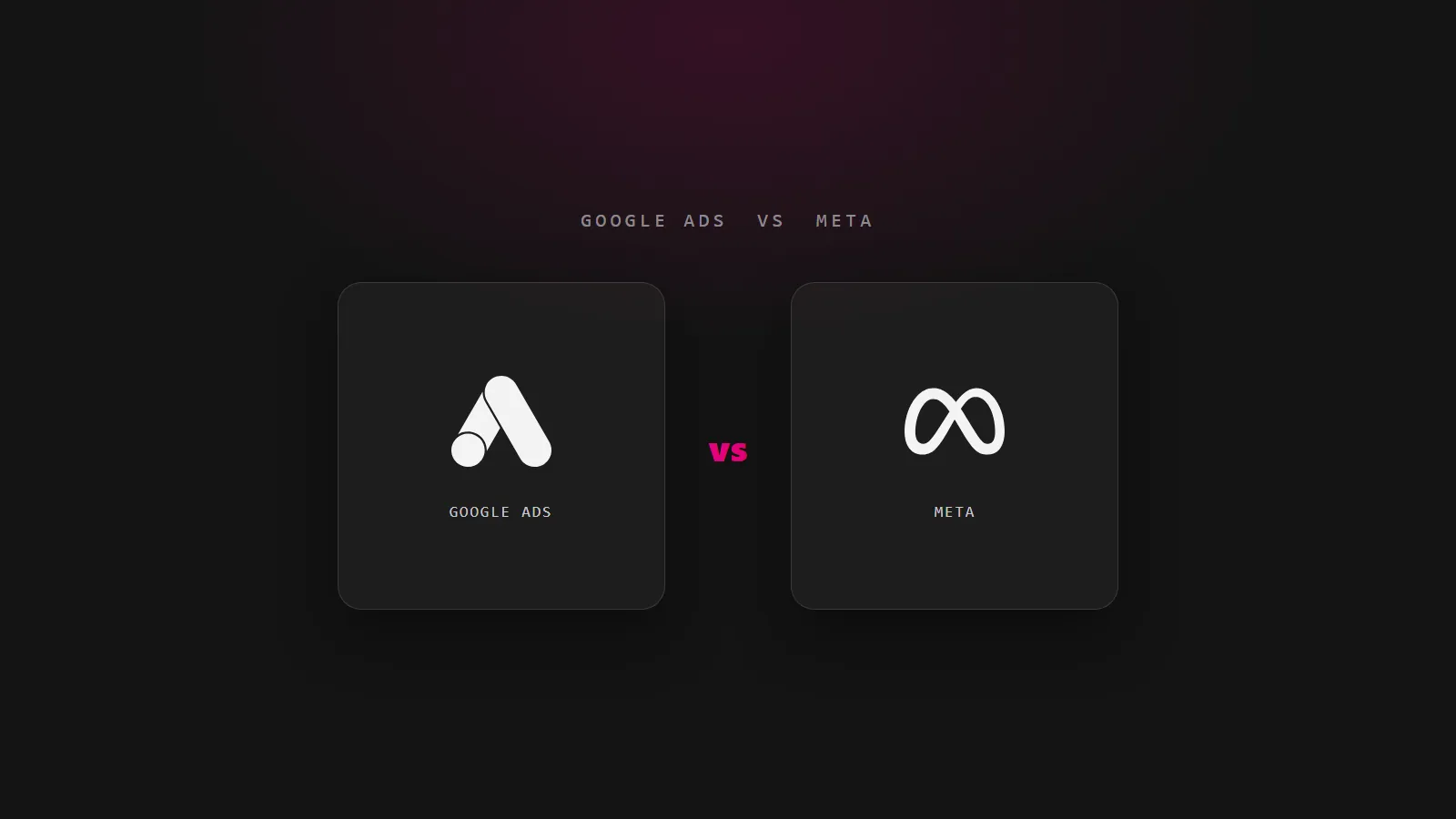
Google Ads vs Facebook Ads comes down to intent. Google Ads captures people already searching for what you sell — existing demand. Facebook Ads (Meta) puts you in front of people who match a profile but aren't searching — created demand. Start where your customers already are: if they search, start with Google; if they don't, start with Facebook.
That single distinction — capturing demand vs creating it — decides which platform to start with, what it costs, and how fast you'll see results. Everything else is detail.
What's the core difference?
- Google Ads (intent-based): your ad appears when someone searches a term you bid on. The person already wants something — you're capturing demand at the moment it exists. Best for products and services people actively look for.
- Facebook Ads (interest-based): your ad appears in a feed based on who the person is, not what they typed. Nobody asked for it — you're creating demand. Best for visual, impulse, or new-category products people don't search for yet.
Google answers a question someone is already asking. Facebook starts the conversation. Both work — they just work at different points in the buying journey.
Google Ads vs Facebook Ads at a glance
The fastest way to choose is to compare them on the dimensions that actually move your cost-per-acquisition:
Google Ads
- Captures existing demand via keywords and search intent
- Bottom-of-funnel, warmer traffic
- Higher cost-per-click, lower cost-per-acquisition
- Low creative dependency — text-driven
- Fast time to first results
- Best for "I need a plumber now"
Facebook / Meta Ads
- Creates new demand via interests, behavior, and lookalikes
- Top- and mid-funnel
- Lower cost-per-click, cost-per-acquisition varies
- High creative dependency — visual-driven
- Slower — needs creative testing
- Best for "I didn't know I wanted this"
Facebook usually wins on the cheaper click. Google often wins on the cheaper customer — because the traffic is warmer. The lowest CPC isn't the same as the lowest cost per sale.
Which should you start with?
Start with Google Ads if people already search for what you sell — a service, a fix, a clear product category. You're meeting demand that exists, so you'll usually see conversions faster and prove ROI sooner.
Start with Facebook Ads if your product is new, visual, impulse-driven, or nobody's searching for it yet. You'll need strong creative to stop the scroll, but it's the only way to reach buyers who don't yet know they want you.
The rule of thumb: search volume decides. If your keywords have real monthly search volume, start on Google. If they don't, start on Facebook and create the demand. Most US service businesses with clear search intent see quicker early wins on Google.
How much budget do you need?
Either platform needs enough spend to gather real conversion data — not a trickle. Plan for a few hundred dollars per week, per platform, for at least 4 to 6 weeks before judging results. The biggest mistake we see is splitting a small budget across both platforms at once: you get noise on both instead of signal on one.
Fund one channel properly, get it profitable, then layer in the second. That discipline is the difference between learning what works and burning a test budget on guesswork.
Do you have to choose just one?
No — and the strongest accounts eventually run both. Once a channel is profitable on its own, the classic combination is Google to capture search demand and Facebook to build awareness and retarget the people Google sends but doesn't close. They're complementary, not competitors. The sequence matters more than the split: prove one, then add the other.
This is exactly the kind of decision our paid media service is built to make for you — picking the right starting platform, structuring the account around your margins, and scaling spend only where it returns. As a nearshore team in Monterrey working US business hours, we run the tests and report on cost-per-acquisition in real time, not on a 12-hour delay.
Do you need an agency to run Google or Meta ads?
You can run either platform yourself, but both reward expertise — and that's why a Google Ads agency or a Meta/Facebook Ads agency exists. The platforms look simple in the dashboard and punish you in the auction: wrong match types, missing negatives, broken conversion tracking, and weak creative quietly inflate your cost-per-acquisition. A specialist earns its fee by avoiding those leaks and optimizing toward revenue instead of clicks.
If you're hiring out, the same firm can usually run both — a combined Google Ads and Meta ads agency keeps your full funnel under one strategy and one set of conversion data, rather than two vendors blaming each other. The rising meta ads agency label is just the newer name for Facebook/Instagram management now that everything sits under Meta. What matters more than the label: that you own the accounts, the fee is a flat rate (not a cut of your spend), and the headline metric on every report is cost-per-acquisition or ROAS.
The bottom line
Choosing between Google Ads vs Facebook Ads isn't about which platform is "better" — it's about where your customers already are. If they search, start with Google and capture that intent. If they don't, start with Facebook and create the demand. Fund one channel until it's profitable, then add the second. Get the starting move right and the rest is optimization.