

















Choosing the right ERP means matching a system to your actual processes, budget, and team — not buying the biggest, most expensive platform on the market. The best-fit ERP is the one your business will actually use end to end. Start from documented requirements, score vendors objectively, and let fit, not price, decide.
The most common ERP mistake isn't picking a "bad" system — it's picking too much system. Companies buy capability they never adopt, then pay for it twice: once in license fees, again in a longer, riskier rollout. This guide is the vendor-neutral way to choose an ERP that fits.
Why the most expensive ERP is rarely the right one
Price tracks breadth and complexity, not fit. A top-tier suite bundles modules for scenarios you may never run, and every extra module is more to configure, integrate, train on, and maintain. That weight shows up as longer implementation timelines and higher total cost of ownership — the leading ingredients in ERP projects that stall or fail.
Your job isn't to buy the most sophisticated ERP. It's to buy the one that runs your processes cleanly and scales as you grow. Capability you don't adopt is just cost and risk wearing a feature badge.
How to choose an ERP, step by step
A disciplined selection beats a flashy demo every time. Work the process in order:
- Map your processes first — list the workflows the ERP must run (order-to-cash, procure-to-pay, inventory, finance, reporting), written before you talk to any vendor.
- Weight what matters — tag each requirement must-have, should-have, or nice-to-have so a long feature list can't outscore your critical few.
- Shortlist three vendors, no more — pick systems that plausibly fit your size and industry, and ignore the rest.
- Demo against your real workflows — make each vendor run your scenario, not their polished script, and watch where it fights your process.
- Score on total cost of ownership — add license, implementation, migration, integrations, customization, training, and support over three years.
- Check integration and scale — confirm it connects to your existing tools and can grow without a re-platform in two years.
ERP selection criteria that actually decide the outcome

Use a weighted scorecard so the decision is objective, not vibes. Rate each shortlisted ERP 1–5 on the criteria that move the needle:
| Criterion | Why it matters | Weight |
|---|---|---|
| Process fit | The system must match your core workflows out of the box | High |
| Total cost of ownership | License is the small part; implementation + support is the real bill | High |
| Implementation time | Longer rollouts cost more and fail more often | High |
| Scalability | It should grow with you, not force a re-platform | Medium |
| Integrations | Must connect to your existing stack cleanly | Medium |
| Customization effort | Heavy custom code raises cost and upgrade pain | Medium |
| Vendor support | Onboarding and ongoing help when something breaks | Medium |
The system with the longest feature list rarely wins this scorecard. The one that fits your weighted needs at the lowest total cost of ownership usually does.
Your ERP requirements checklist and evaluation template
Before you score anything, turn your process map into an ERP requirements checklist — a one-page evaluation template you reuse against every vendor so the comparison stays apples-to-apples:
- Core processes the ERP must run (order-to-cash, procure-to-pay, inventory, finance).
- Must-have vs nice-to-have tag on every requirement.
- Integrations with your existing stack (CRM, e-commerce, payroll, banking).
- Scale assumptions — entities, currencies, users, transaction volume in 3 years.
- Compliance and reporting obligations specific to your industry.
- Total-cost lines to price out: license, implementation, migration, training, support.
Filled in, this checklist is your buyer's guide — it stops a slick demo from overwriting what your business actually needs.
NetSuite vs Odoo vs Dynamics: a vendor-neutral read
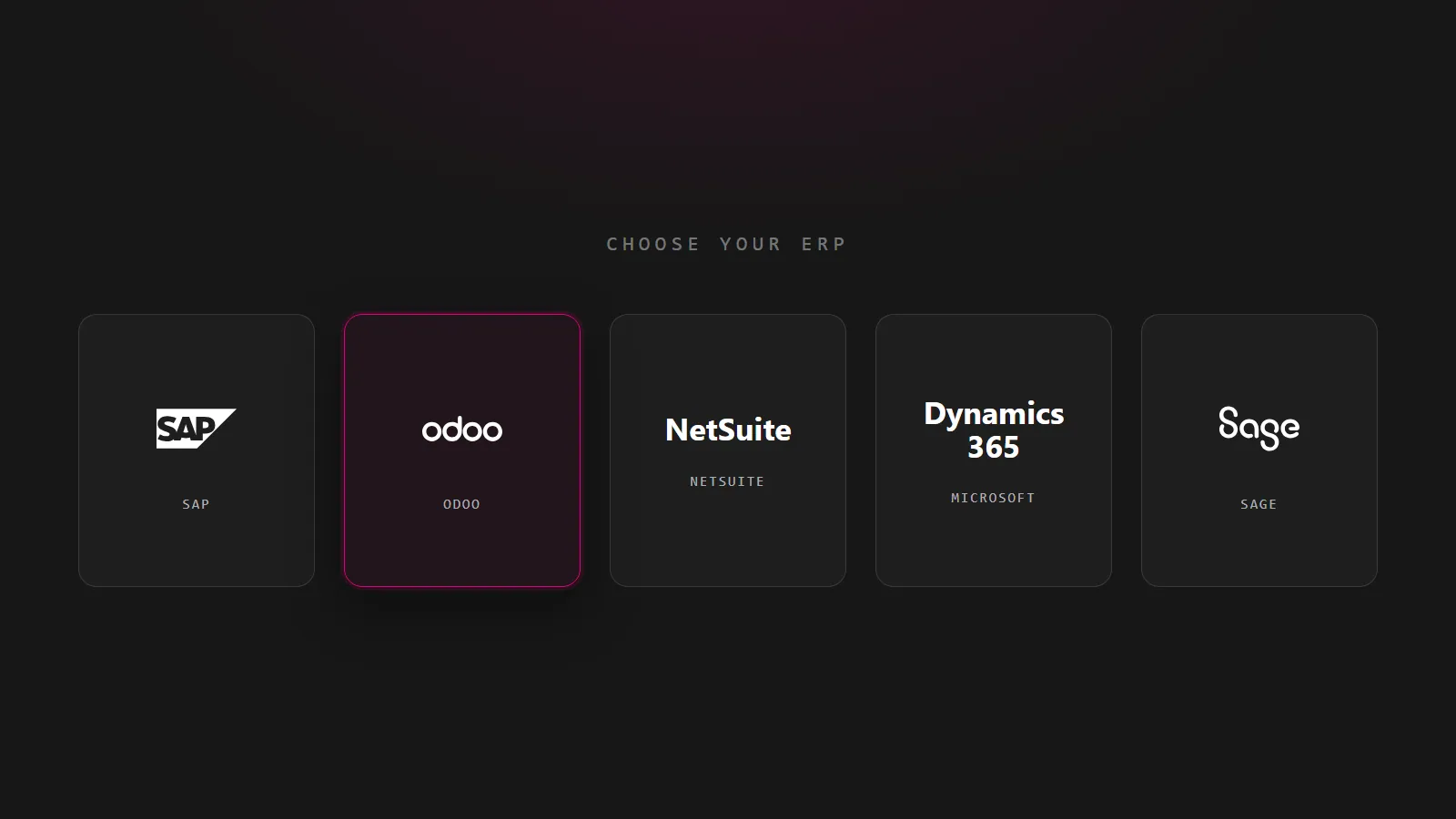
There's no universal best ERP — only a best fit for your situation. As a quick orientation: Odoo suits lean, cost-sensitive teams that want modular, open-source flexibility; NetSuite fits growing mid-market companies that want cloud-native finance and ERP in one suite; Microsoft Dynamics fits Microsoft-centric organizations with complex operations and existing 365 investments. SAP and Acumatica earn a shortlist seat for heavier or distribution-led operations.
Run all three through the same scorecard. For the full head-to-head — fit, cost, and complexity per platform — see our NetSuite vs Odoo vs Dynamics comparison. A neutral comparison — the kind vendors won't give you, because each is selling their own license — is exactly where a best-fit decision gets made.
De-risk the decision before you commit
Most ERP failures are scoping failures: too much system, fuzzy requirements, no fixed boundaries. Lock the scope, phase the rollout, and get a fixed-scope cost estimate so the number can't quietly balloon mid-project. This is the core of a sound ERP implementation approach — and where a vendor-neutral consultant earns their fee by saving you money, not selling you licenses.
If you already run an ERP, you don't have to rip and replace to modernize. Connecting AI agents on top of your existing system — across the data you already have — can supercharge analysis, quoting, and internal processes without a new platform.
The bottom line
Choosing an ERP is a fit decision, not a budget contest. Map your processes, weight your requirements, shortlist three vendors, and score them on total cost of ownership — and the right system, not the most expensive one, will rise to the top. When the stakes are high and the options blur, a vendor-neutral partner whose job is to save you money is the cheapest insurance you can buy.