





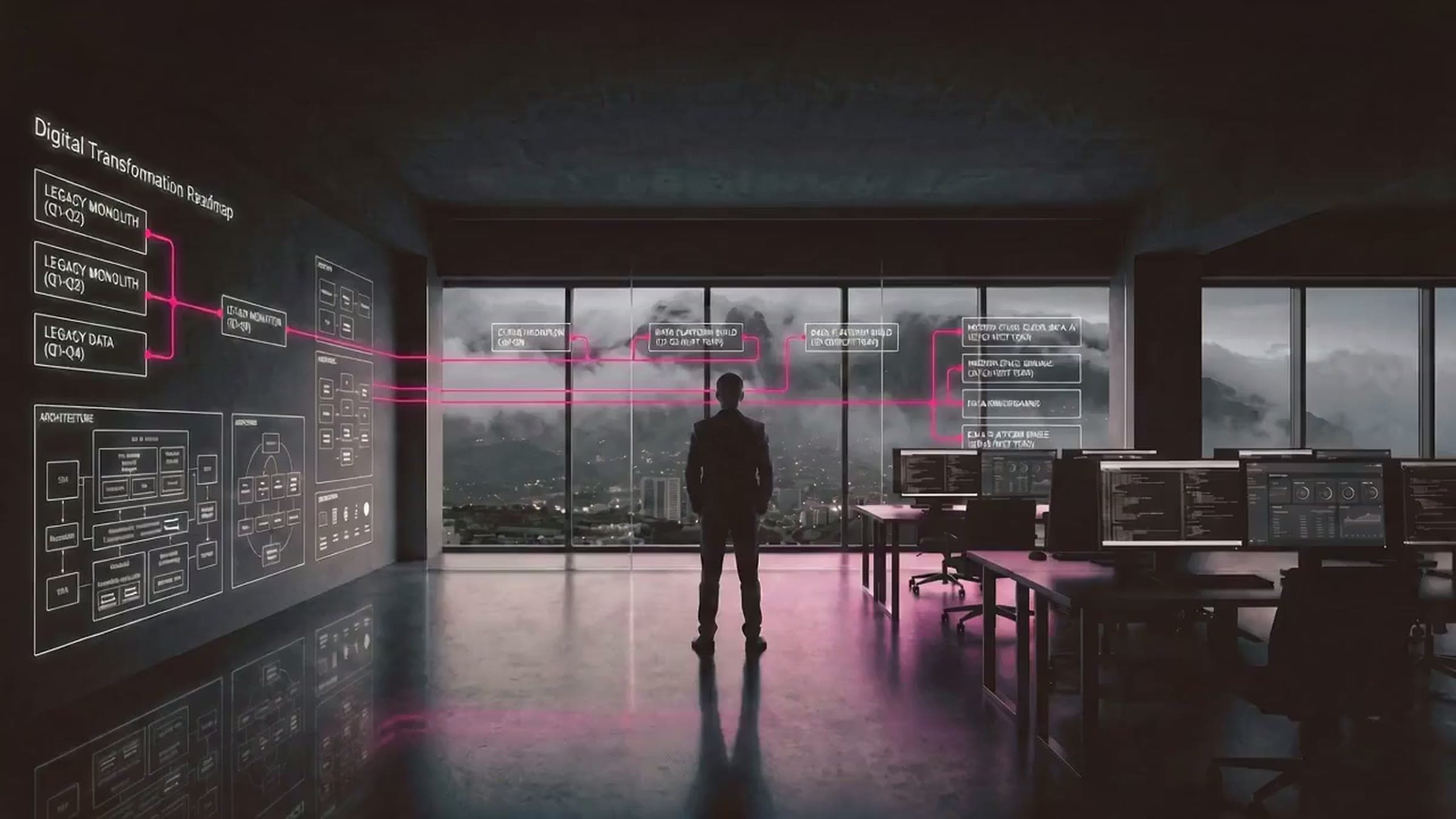








A legacy modernization strategy is the staged plan for upgrading aging software so it runs on modern infrastructure without disrupting the business. Instead of one risky big-bang rewrite, it sequences the work — assess, prioritize, wrap, modernize, retire — so the system keeps serving customers while it evolves underneath them.
The hard part of legacy modernization was never the new technology. It's doing the upgrade without breaking operations. That's what a real strategy is for: turning a scary rewrite into a series of small, reversible steps.
What is a legacy modernization strategy?
A strategy answers three questions before any code changes: what to modernize, in what order, and with which approach. Skip it, and modernization becomes a multi-year rewrite that quietly drifts off-spec while the old system rots in parallel. With it, every system gets the right treatment — some retired, some lifted as-is, only the high-value pieces rebuilt.
The cost of not having one is what pushes most teams to act: rising maintenance bills, scarce talent for old stacks, security gaps, and systems too brittle to add features to. A strategy converts that pressure into a plan.
The 7 Rs: choosing an approach per system
Legacy modernization strategies are built from the 7 Rs — a menu of approaches you apply system by system, not a single path for the whole estate.
| Approach | What it does | Risk | Best for |
|---|---|---|---|
| Retain | Leave it as-is, for now | None | Systems that still work and aren't blocking anything |
| Retire | Decommission it | Low | Redundant or unused systems |
| Rehost | Lift-and-shift to new infra | Low | Quick cloud moves, no code change |
| Replatform | Minor tweaks for a new platform | Low–Med | Small wins (e.g. managed database) |
| Refactor | Restructure the code, same behavior | Medium | Reducing tech debt in code you keep |
| Rearchitect | Reshape into modern architecture | High | Monoliths that need to scale |
| Rebuild | Rewrite from scratch | Highest | Systems that genuinely can't be salvaged |
Most plans mix several Rs: retire the dead weight, rehost the stable bits, and reserve rearchitect or rebuild for the few systems that earn it. Among legacy modernization strategies, the cheapest win is almost always honest scoping — not modernizing what you could simply retire.
The step-by-step plan
A modernization strategy runs in five stages, each one designed so you can stop, measure, and roll back before committing further.
- Assess and inventory — Map every system: what it does, what depends on it, and how painful it is to maintain.
- Prioritize by value and risk — Rank systems so high-value, high-pain ones go first and the 7 Rs get assigned.
- Wrap in APIs — Put a stable boundary around the legacy system so modern apps and AI tools can talk to it today.
- Modernize incrementally — Replace one capability at a time with rollback, using the strangler-fig pattern.
- Retire and optimize — Decommission each legacy piece once the new system fully handles it.
1. Assess and inventory
Map every system: what it does, what depends on it, what business logic it holds, and how painful it is to maintain. AI-assisted tooling now reads and documents legacy code far faster than a manual audit — which is how an assessment that used to take a quarter compresses into weeks.
2. Prioritize by value and risk
Rank systems by business value against modernization risk. High-value, high-pain systems go first; stable, low-impact ones can wait or be retained. This is where the 7 Rs get assigned.
3. Wrap in APIs (build a stable boundary)
Before changing anything, put APIs around the legacy system so modern apps, cloud services, and AI tools can talk to it today. This boundary is what lets you modernize behind it without the rest of the business noticing.
4. Modernize incrementally (strangler-fig)
Replace functionality one slice at a time. The new component takes over a single capability; the old system handles everything else until that slice is proven in production. Each step ships with rollback. The old system shrinks gradually instead of being switched off in one terrifying weekend.
5. Retire and optimize
Once a capability is fully handled by the new system, decommission the legacy piece. Repeat until the old stack is gone — or kept only where it still earns its place.
Modernize vs rebuild: don't bet the business
The default should be incremental modernization, not a from-scratch rewrite. A big-bang rebuild throws away years of hard-won business logic and asks the business to go dark during cutover — the single most common way modernization projects fail. Rebuild only the parts that are too coupled or brittle to evolve; preserve everything that still works. WeEvolveIT's legacy system modernization service is built around exactly this principle: modernize behind a stable boundary, stage by stage, so operations run throughout. For the full per-system breakdown, see our 7 Rs of modernization approaches guide and how to integrate legacy systems with modern platforms.
Why a nearshore team fits modernization
Modernization is collaboration-heavy: every cutover, every API contract, every "can we retire this?" needs a live decision. That's why time-zone overlap matters more here than on greenfield builds. A senior nearshore team in Mexico — fluent in both old stacks and modern cloud and AI — works your hours, so those decisions happen in real time instead of on the 24-hour delay you get from an offshore vendor in India or Dubai. From Monterrey, that team is a short flight and a shared workday away from a US client, on a flat fee where you own the code and accounts rather than renting them.
The bottom line
A legacy modernization strategy is what turns a high-stakes rewrite into a series of small, reversible steps. Assess honestly, assign the right R to each system, wrap the old code in APIs, and modernize one slice at a time with rollback ready. Do that — ideally with a nearshore team that lives in your time zone — and you get modern systems without ever betting the business to get there.