



















"How much does mobile app development cost?" has the same honest answer as "how much does a house cost?" — it depends on what you're building. But you came for numbers, so here they are up front, in ranges, with the caveat that rates vary by region and team and these are estimates, not quotes:
- Simple app — roughly $15K–$50K. A few screens, login, one core feature, an existing backend.
- Mid-complexity app — roughly $50K–$150K. Custom UI, several integrations, a backend you build, accounts and payments.
- Complex app — $150K–$500K+. Real-time data, heavy integrations, multiple user roles, security and compliance work.
A US agency sits at the top of each band; a nearshore team delivers comparable quality nearer the bottom, often for around half the US agency price, because the rate is lower — not the standard. The rest of this guide explains what moves you up or down inside those ranges, and how to spend less without shipping something worse.
What actually drives mobile app cost
Almost every dollar in an app budget traces back to build time plus testing time, and a short list of decisions controls both. These are the levers — the "it depends" made concrete.
1. Complexity and feature count
This is the biggest lever by far. A login, a feed, and a settings screen is one order of magnitude; live chat, geolocation, payments, offline sync, and an admin dashboard is another. Every feature is design + build + test, so feature count compounds — ten features cost more than twice as much as five, because they also interact. The fastest way to control an app budget is to control the feature list.
2. Number of platforms
Shipping iOS and Android is more work than one. With a native approach that can mean close to two builds. With cross-platform, one codebase covers both — which is why platform count and the next lever are tied together.
3. Native vs cross-platform
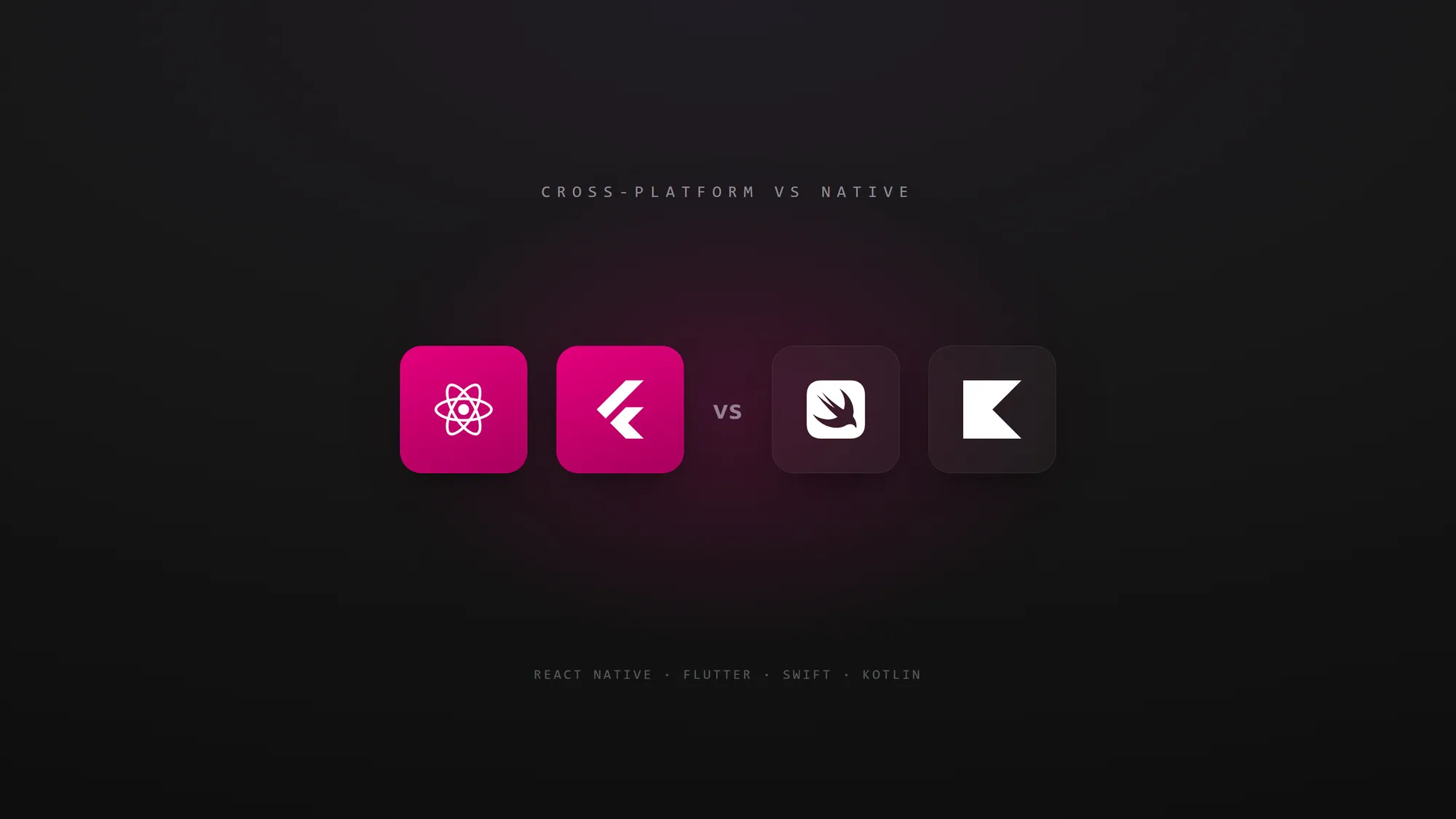
Native (Swift for iOS, Kotlin for Android) gives maximum performance and platform fidelity, at the cost of two codebases. Cross-platform (React Native, Flutter) ships both stores from one codebase — typically faster and cheaper to build and maintain, and good enough for the large majority of apps. The right call depends on your performance needs; we break the trade-off down in cross-platform vs native.
4. Design
A template-driven UI is inexpensive. Custom design — bespoke screens, motion, a distinctive brand feel, an actual UX research pass — is a real line item. Good design pays for itself in retention, but it is not free, and "make it look custom" is one of the quieter ways a budget grows.
5. Backend and integrations
If your app talks to anything — a payment processor, a CRM, maps, push notifications, your existing systems — each integration is build time plus the testing to make it reliable. Building a new backend (APIs, database, auth, hosting) is a substantial slice of the total. Reusing an existing backend is one of the biggest savings available.
6. Security and compliance
A consumer to-do app and a HIPAA-regulated health app are not the same project. Encryption, audit logging, penetration testing, and compliance work (HIPAA, PCI, SOC 2, GDPR) add cost — necessary cost — and they're non-negotiable in regulated industries. Know which rules apply before you budget.
7. Maintenance
The line item teams forget. iOS and Android ship breaking changes every year; libraries deprecate; security patches can't wait. Budget 15–25% of the build cost per year to keep the app healthy. An app is a living system, not a one-time purchase.
App cost by complexity tier
Here's how those levers add up into rough tiers. Treat the numbers as estimates to frame a conversation, not quotes — your real number depends on your exact features, platforms, and integrations.
Simple / MVP
$15K–$50K
4–8 screens, login, one core feature, existing backend, cross-platform · 1.5–3 months
Mid-complexity
$50K–$150K
Custom UI, accounts + payments, several integrations, a backend you build · 3–6 months
Complex
$150K–$500K+
Real-time data, many integrations, multiple roles, offline sync, security/compliance · 6–12+ months
Two apps in the same row can still differ widely — a "simple" app with a beautiful custom design can cost more than a plain mid-complexity one. The tier sets the ballpark; the seven drivers above set where you land in it. For how the timeline column is built, see how long it takes to build an app.
How to reduce cost without wrecking quality
The wrong way to save money is to skip testing or hire the cheapest bidder — both just move the cost to later, with interest. The right way is to cut scope and overhead, not craft.
-
Go cross-platform. One codebase for iOS and Android is usually the single biggest legitimate saving, on both the build and every year of maintenance after. Unless you have a hard performance reason for native, start here.
-
Scope a real MVP. Ship only the features that prove the idea, launch, then fund the rest from what you learn. Most "must-have" features in a v1 are actually v2 — building them up front is the most common way budgets blow up. Build the smallest thing that's genuinely useful.
-
Reuse what you have. An existing backend, a design system, an auth provider, an off-the-shelf payments SDK — every wheel you don't reinvent is build time you don't pay for.
-
Go nearshore. This is our wedge, and the math is simple: a nearshore team in your timezone delivers agency-grade work at materially lower rates than a US agency — often around half the cost for comparable quality. The savings come from the rate, not from cutting corners. That's the core of our nearshore software development model, and it's how we approach every mobile app development build.
The thread connecting all four: spend on the work that creates value (the right features, built well and tested), and stop spending on everything else (extra scope, duplicated platforms, reinvented wheels, and inflated rates).
In-house vs agency vs nearshore
Who builds the app changes the cost as much as what you build.
- In-house — maximum control, highest fixed cost. You're paying salaries, benefits, and months of hiring before any code ships. It makes sense when the app is core to your business and you'll keep evolving it for years.
- US agency — fast to start, senior teams, the highest hourly rates on the market. You pay a premium for proximity and brand.
- Nearshore — agency-grade teams and process at lower rates, in your timezone, with real-time overlap for standups and reviews. For most US companies this is the sweet spot: roughly half the cost of a US agency for work of comparable quality.
Nearshore isn't "offshore but closer" — the timezone overlap is the point. It's why the quality holds while the rate drops.
The bottom line
Mobile app development costs anywhere from about $15K for a simple MVP to $500K+ for a complex platform, and the honest answer to "how much" is always a range until your features, platforms, and integrations are pinned down. The price is driven by complexity, platform count, native vs cross-platform, design, integrations, security, and ongoing maintenance — and you control most of it. To spend less without shipping less: go cross-platform, scope a real MVP, reuse what you can, and build nearshore. Get the scope right and the same app can cost half of what a US agency would charge — without the quality costing you anything.