

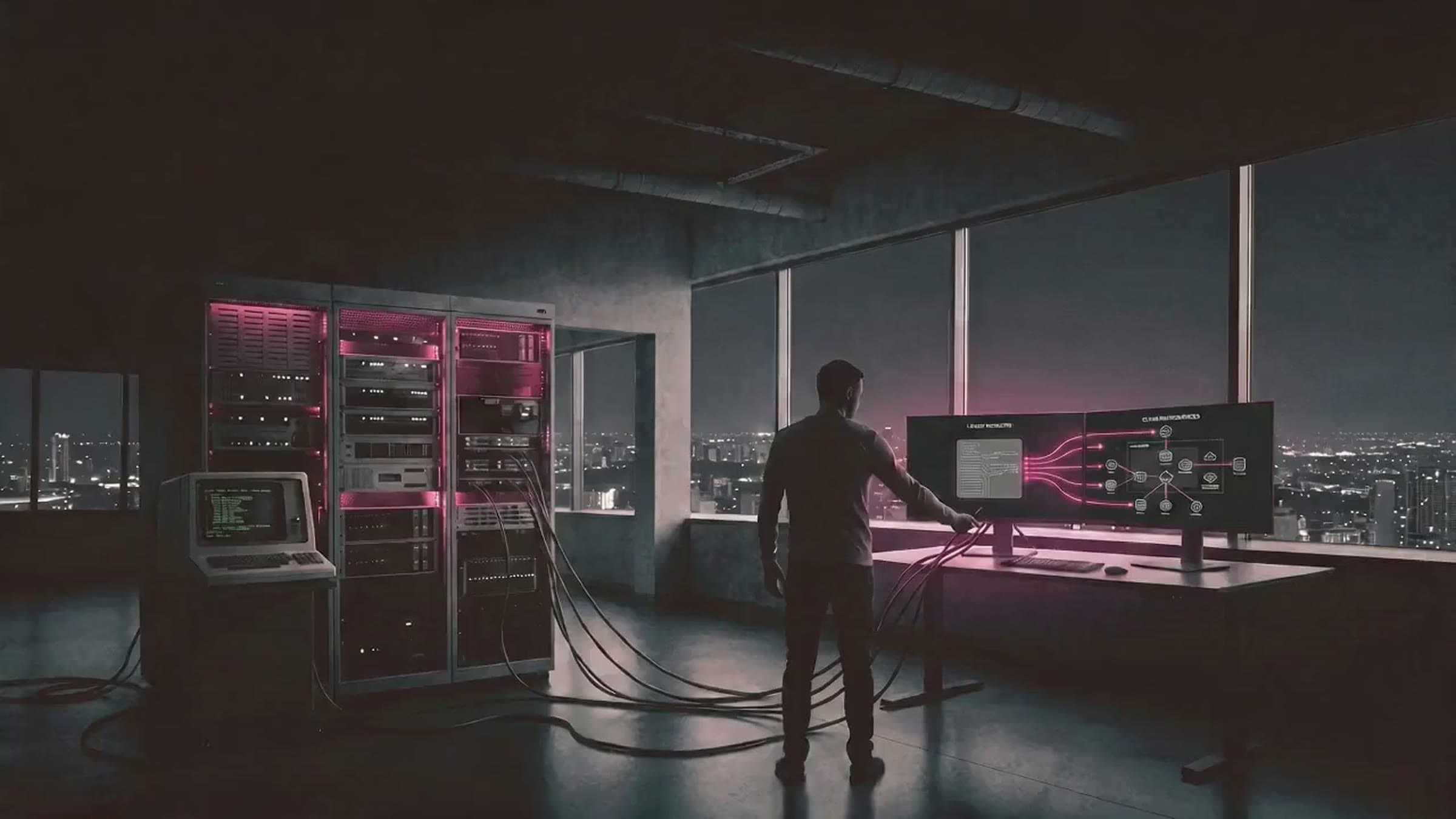






On-premise to cloud migration is the process of moving your applications, data, and infrastructure out of a data center you own and onto a cloud platform like AWS, Azure, or GCP. It runs in phases — discover, assess, plan, migrate, cut over, and optimize — and is usually done in waves rather than one risky big-bang move.
The hard part isn't spinning up cloud resources. It's doing it without breaking what already works — keeping data intact, downtime near zero, and the bill under control after you land. This checklist is the operator's plan for exactly that.
- Discover — inventory every workload, map dependencies, and capture baselines and compliance constraints.
- Assess — assign one of the 6 Rs to each workload during the assessment phase.
- Plan — pick the target platform, build the landing zone, and group workloads into waves.
- Migrate and cut over — replicate data continuously, test in parallel, switch in a low-traffic window with rollback ready.
- Optimize and run — FinOps, observability, and SRE so cloud bills and reliability stay under control.
The cloud migration checklist starts with discovery
You can't migrate what you can't see. Every successful on premise to cloud migration starts with an honest inventory of the estate:
- Catalog every workload — applications, databases, batch jobs, internal tools, and the forgotten server nobody admits to owning.
- Map dependencies — what talks to what. Hidden integrations are the #1 source of migration surprises.
- Measure baselines — current CPU, memory, storage, and traffic, so you can right-size in the cloud instead of copying oversized hardware.
- Flag compliance and data residency — HIPAA, SOC 2, PCI, and where data is legally allowed to live.
- Define success metrics — target cost, performance, and the downtime budget you're allowed for each app.
Skip this and you migrate blind. The discovery phase is where the real plan gets written.
Assess each workload: the 6 Rs
Once you can see the estate, you decide how to move each piece. The industry standard is the 6 Rs — assign exactly one to every workload:
| Strategy | What it means | Best for |
|---|---|---|
| Rehost | Lift-and-shift as-is | Fast data-center exit, stable apps |
| Replatform | Lift, then minor reshaping (e.g. managed DB) | Quick cloud-native wins, low risk |
| Repurchase | Drop the app, move to SaaS | Commodity tools (email, CRM, HR) |
| Refactor | Re-architect for the cloud | High-value apps needing scale |
| Retain | Keep on-prem for now | Legacy or compliance-locked systems |
| Retire | Decommission entirely | Dead weight nobody uses |
Most portfolios end up a mix. Rehost and replatform do the early heavy lifting because they get you out of the data center fast; refactor is where you invest later, on the workloads that justify the engineering.
Lift-and-shift vs re-architect
The recurring question is whether to rehost or re-architect. Rehost is fastest and lowest-risk — ideal for exiting a lease or moving stable apps. Re-architect unlocks cloud-native scaling and lower run costs but takes real engineering time. The pragmatic pattern: rehost first to get out, then re-architect the high-value workloads once they're safely in the cloud.
Plan the migration: landing zone and waves
With strategies assigned, you build the foundation and sequence the moves:
- Pick the target platform — AWS, Azure, or GCP, chosen by fit, not by habit. A vendor-neutral assessment matters here.
- Build the landing zone — accounts, networking, IAM, guardrails, and logging before any workload arrives.
- Group workloads into waves — start with low-risk, low-dependency apps to prove the pipeline, then escalate.
- Set up CI/CD and infrastructure-as-code — so environments are repeatable, not hand-built and un-reproducible.
Waves matter because they let you ship value and learn early instead of betting the whole estate on one cutover weekend.
Migrate and cut over without downtime
This is the moment everyone fears, and it's controllable with a checklist. The cloud data migration is the riskiest part — moving live databases without losing a row or a transaction — so it gets its own discipline:
- Replicate data continuously ahead of cutover so the cloud copy is current. Continuous database replication (AWS DMS, Azure Database Migration Service, or native log shipping) is what makes a low-downtime cloud data migration possible.
- Run both environments in parallel — test the workload in the cloud while on-prem still serves real traffic.
- Validate functionality, performance, and integrations against your baselines before you switch.
- Cut over in a low-traffic window using DNS or load-balancer switching for a minutes-not-hours transition.
- Keep a tested rollback path — the cutover is only safe if you can reverse it.
Continuous replication plus parallel testing is what keeps most cutovers to minutes of downtime instead of an outage.
After landing: optimize and run
The migration isn't done when traffic moves — that's when cloud bills tend to balloon. The final, ongoing phase:
- FinOps — right-size instances, kill idle resources, and add cost alerts so the bill doesn't surprise you.
- Observability — monitoring, logging, and alerting tuned for the cloud.
- SRE and automation — bake reliability and patching into pipelines rather than tickets.
Migration without this last phase just moves your data center into someone else's building at a higher price. This is the work our cloud migration services team folds into every move — migration, DevOps, and FinOps as one engagement, run by senior nearshore engineers in your time zone from Monterrey on a flat fee. Unlike an offshore India or Dubai shop, the cutover happens during your business hours, not across a twelve-hour gap — and you own the cloud accounts and IP from the first commit.
The bottom line
A clean on-premise to cloud migration is a sequence, not a leap: discover, assess with the 6 Rs, build a landing zone, migrate in waves, cut over with a rollback plan, then optimize. Rehost to get out of the data center fast, re-architect the workloads that earn it, and treat FinOps as part of the project — not an afterthought. Run it in that order and you move off-prem without breaking what works.