






















Generative engine optimization (GEO) is the practice of structuring your content so AI search engines — ChatGPT, Perplexity, Gemini, and Google's AI Overviews — pull from it and cite it as a source inside the answer they generate. Answer engine optimization (AEO) is its close cousin: getting picked as the single, extracted answer to a direct question.
Both exist for one reason: search no longer ends on a page of blue links. People ask an AI a question and read the synthesized answer. If your content isn't quoted in that answer, you're invisible — no matter how well you rank.
What is GEO?
GEO optimizes your content to be quoted inside an AI-generated answer. When someone asks ChatGPT or Perplexity a question, the engine writes a synthesized response and names a handful of sources. GEO is the work that gets you named.
It builds on traditional SEO — crawlable, fast, authoritative pages — but adds three things SEO never had to prioritize: self-contained extractable answers, clear entity and authority signals, and source-worthiness (data, named references, and a track record the AI can trust).
What is AEO?
AEO optimizes your content to be the extracted answer — the featured snippet, the voice-assistant response, the direct answer box. Where GEO is about being one of several cited sources in a longer synthesis, AEO is about owning the single short answer to a specific question.
In practice the two overlap almost completely. The same moves that win a featured snippet — a tight definition up top, structured Q&A, FAQ schema — are the moves that get you cited by a generative engine.
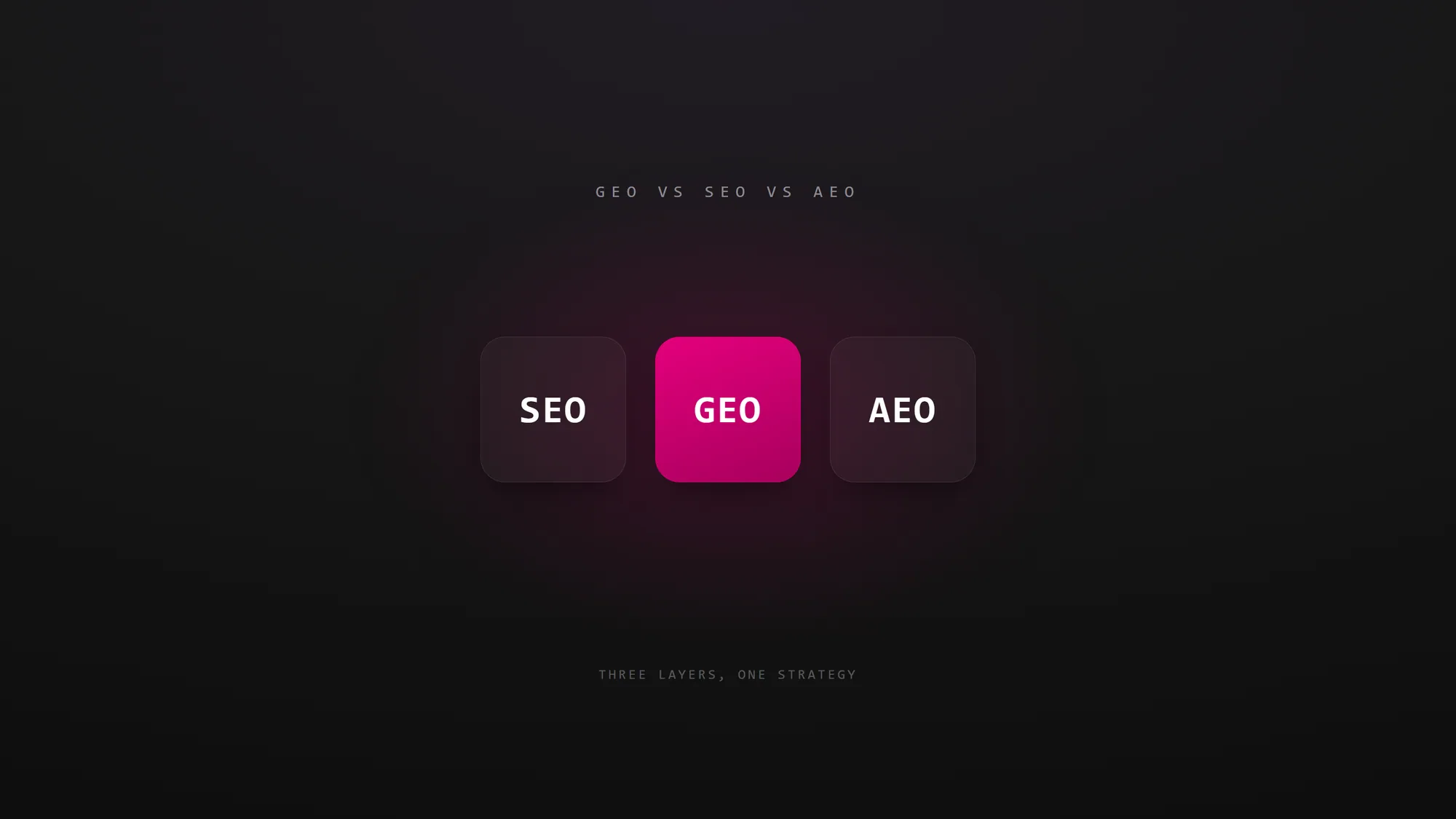
GEO vs AEO vs SEO
The three layers stack. They share a foundation but optimize for different surfaces:
| SEO | AEO | GEO | |
|---|---|---|---|
| Goal | Rank in the list of links | Be the extracted answer | Be cited inside the AI answer |
| Surface | Google results page | Featured snippet · voice | ChatGPT · Perplexity · AI Overviews |
| User action | Clicks a link | Reads the snippet | Reads the synthesized answer |
| Key signal | Authority + relevance | Direct, structured Q&A | Source-worthiness + entity clarity |
| Output | Traffic | Zero-click answer | A citation (and the trust it carries) |
None of these replaces the others. AI engines tend to pull from pages that already rank, so SEO is the floor. GEO and AEO are the layers you build on top to stay visible as search shifts from links to answers.
How to get cited by AI search
Getting cited by an answer engine isn't a trick — it's making your content the easiest, most trustworthy thing to quote. The checklist:
| Tactic | Why it works |
|---|---|
| Lead with a 40–50 word answer | AI engines extract the clearest, earliest direct answer — don't bury it under an intro. |
| Write self-contained passages | Each block should make sense quoted on its own, with no "as mentioned above." |
| Add FAQ + structured schema | FAQPage and structured data tell engines exactly which text answers which question. |
| Cite data and named sources | Source-worthy pages reference real numbers and named references the AI can trust. |
| Build topical authority | Cover a topic in depth so engines treat you as the entity to cite, not a one-off page. |
| Stay crawlable and fast | If a bot can't read it cleanly, it can't quote it. |
The pattern: answer the question directly, early, and in a quotable block — then earn the trust that makes an engine choose you over the next source.
GEO and AEO for local and ecommerce search
Generative engine optimization and answer engine optimization aren't only for broad informational queries — they change how local and ecommerce search work too. When a shopper asks an AI for "the best running shoes under $150" or a buyer asks for "a good plumber in Austin," the engine answers and cites a few sources. For ecommerce, that means structuring product data so AI can quote specs and reviews; for local, it means making your service-area and review signals extractable. The same definition-first, schema-backed playbook applies on top of your existing local or ecommerce SEO — it just earns you the citation instead of the click.
Why this matters now
Ranking #1 on Google isn't enough when the AI gives the answer and names only a few sources above the fold. A user can get everything they need without ever clicking — so the win is no longer the click, it's the citation. Being one of the named sources in an AI answer is the new front page.
Most agencies still sell SEO alone and haven't built GEO or AEO into how they work. That gap is exactly why we fold generative and answer engine optimization into our SEO service — and why this site is built that way from the ground up. If an AI engine cited the page that brought you here, that's the method working in real time.
The bottom line
GEO and AEO are how you stay visible as search moves from a list of links to a single AI-written answer. AEO gets you the extracted answer; GEO gets you cited inside the synthesis; both sit on top of solid SEO. Lead every page with a clear, quotable answer, back it with data and schema, and build the authority that makes AI engines treat you as a source worth naming. Do that, and you don't just rank — you get cited.