











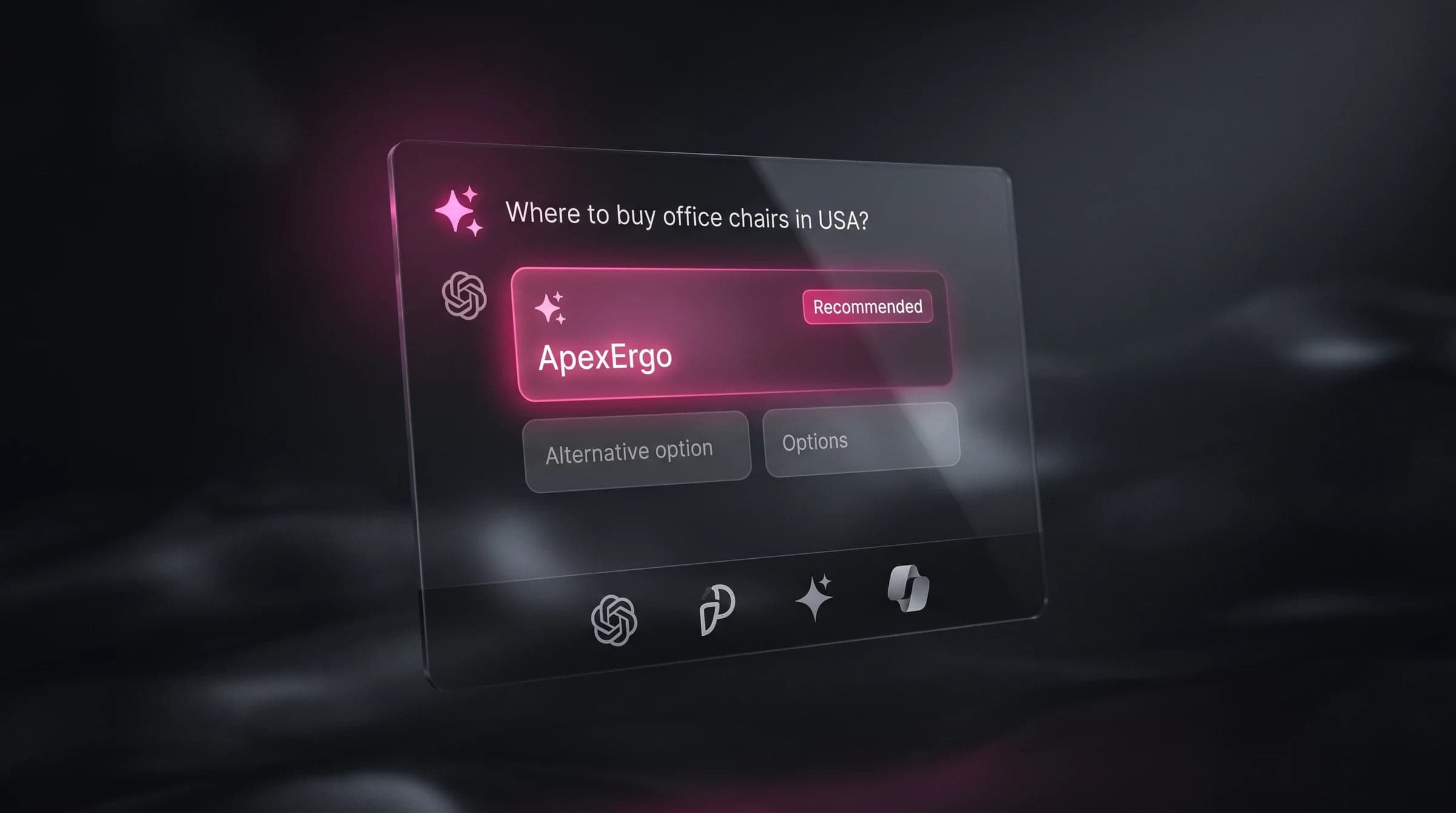




Your business isn't showing up in ChatGPT usually for one reason: your content isn't structured for AI to extract and cite it. ChatGPT, Perplexity, and Gemini don't show a list of ten blue links; they write an answer and name a handful of sources. If yours isn't easy and trustworthy to cite, you're left out of the conversation, right where buying decisions now happen.
The good news: it's fixable, and not with a trick. It's about making your site the easiest, most trustworthy thing for an AI engine to cite. Here's why you're not showing up, how to check how bad it is, and what to do about it.
First: run the test yourself
Before any theory, prove it. Open ChatGPT or Perplexity and ask the way a customer would: "what are the best [your industry] companies in [your city]?" or "recommend a [your product or service]." Read the answer and notice who it names.
If your business isn't among the cited sources, that's not bad luck, it's a signal. The engine found content that was easier to extract and trust than yours. The question is no longer whether you rank, but whether the AI answer your customer is reading cites you.

Why your business isn't showing up in ChatGPT
When we audit sites that "don't show up in AI," it's almost always a mix of these five causes:
| Cause | What it means |
|---|---|
| Your content isn't extractable | The answer is buried under introductions. AI pulls short, self-contained blocks; if yours isn't one, it takes someone else's. |
| You lack authority | Engines cite sources they trust. Without authority signals (thorough content, references, a consistent entity), you're not a candidate. |
| You're not in the sources AI reads | AI synthesizes from your site, reviews, directories, and mentions. If your presence there is thin, there's nothing to cite you from. |
| Your information isn't concrete | With no numbers, prices, data, or clear location, your page gives the engine nothing citable. Vague doesn't get cited. |
| You block AI crawlers | If your robots.txt or your site stops crawlers like GPTBot or PerplexityBot from reading you, you can't be cited, full stop. |
Most pages fail on the first two. They're written to impress a human skimming, not so an engine can extract a clean answer. Size doesn't protect you either: in our AI Visibility Index 2026, 65 of Mexico's largest companies averaged 47/100 for AI citability.
How to check how bad it is
Don't guess, measure. Three quick checks:
- The direct test. Ask ChatGPT and Perplexity the 3 or 4 questions your ideal customer would ask. Note who shows up and who doesn't.
- The technical test. Confirm your site doesn't block AI crawlers and that your key pages carry structured data (schema).
- The content test. Open your main pages: is the first answer in the first 50 words, or do you have to scroll three paragraphs to find it?
To skip doing it by hand, we built a free tool that does exactly this for you: it checks how AI search sees you, measures how citable you are, and tells you exactly where you're falling short. Almost no agency offers this, and for you it's free: check your AI visibility for free. It's the fastest way to go from "I think I'm not showing up" to "I know exactly why, and what to fix."

How to get AI to actually mention you
Showing up in ChatGPT isn't a hack: it's making your content the easiest, most trustworthy thing to cite. The playbook:
| Tactic | Why it works |
|---|---|
| Answer in the first 40–50 words | AI engines extract the clearest, earliest direct answer. Don't bury it. |
| Write self-contained blocks | Each paragraph should make sense quoted on its own, no "as we said above." |
| Add FAQ schema and structured data | They tell the engine exactly which text answers which question. |
| Use data and named sources | Real numbers and concrete references give you source-worthiness the AI can trust. |
| Build topical authority | Cover your subject thoroughly so AI treats you as the entity to cite, not a stray page. |
| Let AI crawlers in | If a crawler can't read you cleanly, it can't cite you. |
The pattern mirrors classic SEO, with a twist: instead of writing to win a click, you write to win a citation. This is called GEO (generative engine optimization) and AEO (answer engine optimization). If you want the definitions, we break them down in What is GEO & AEO?. For the full step-by-step on becoming a cited source, see How to rank on ChatGPT. For Perplexity and Google specifically, see how to get cited by Perplexity and Google AI Overviews.
How long does it take?
It depends on where you start. If your site already ranks well on Google, structuring your content for AI can start paying off in weeks, because generative engines tend to pull from pages that already have authority. If you start from a weak site, you have to build that base first, and that's a matter of months. It's not a switch you flip: it's a layer that compounds over time.
GEO and AEO don't replace SEO
A common misread: this doesn't replace SEO, it stacks on top of it. AI engines usually cite pages that already rank well, so solid SEO stays the floor. GEO and AEO are the layers you build above it to stay visible as search shifts from a list of links to a single answer. That's why we offer generative engine optimization services, bake all three into our SEO service, and build this site that way from the foundation up. If an AI engine cited the page that brought you here, that's the method working in real time.
The bottom line
Your business isn't showing up in ChatGPT because your content isn't built for AI to extract and cite it: the answer is buried, authority is thin, or the engine has nothing to pull you from. The fix isn't a trick, it's making yourself easy and trustworthy to cite: answer directly and early in a self-contained block, back it with data and schema, let AI crawlers in, and build authority. Run the test today, ask ChatGPT about your industry, and if you're not there, you now know where to start.