


















Mobile app development is the process of building software that runs on phones and tablets — for iOS, Android, or both. It covers the whole lifecycle: discovery, design, building the app and its backend, testing on real devices, publishing to the stores, and maintaining it after launch. The output isn't a mockup or a prototype — it's a working product people install and use.
That's the short version. The longer version is mostly about choices: which type of app to build, how the work actually flows, and what makes one project cost twice as much as another. This guide walks through all three.
The types of mobile apps
Before any code is written, one decision shapes everything after it: what kind of app are you building? There are three common answers, and they trade performance against cost and reach.
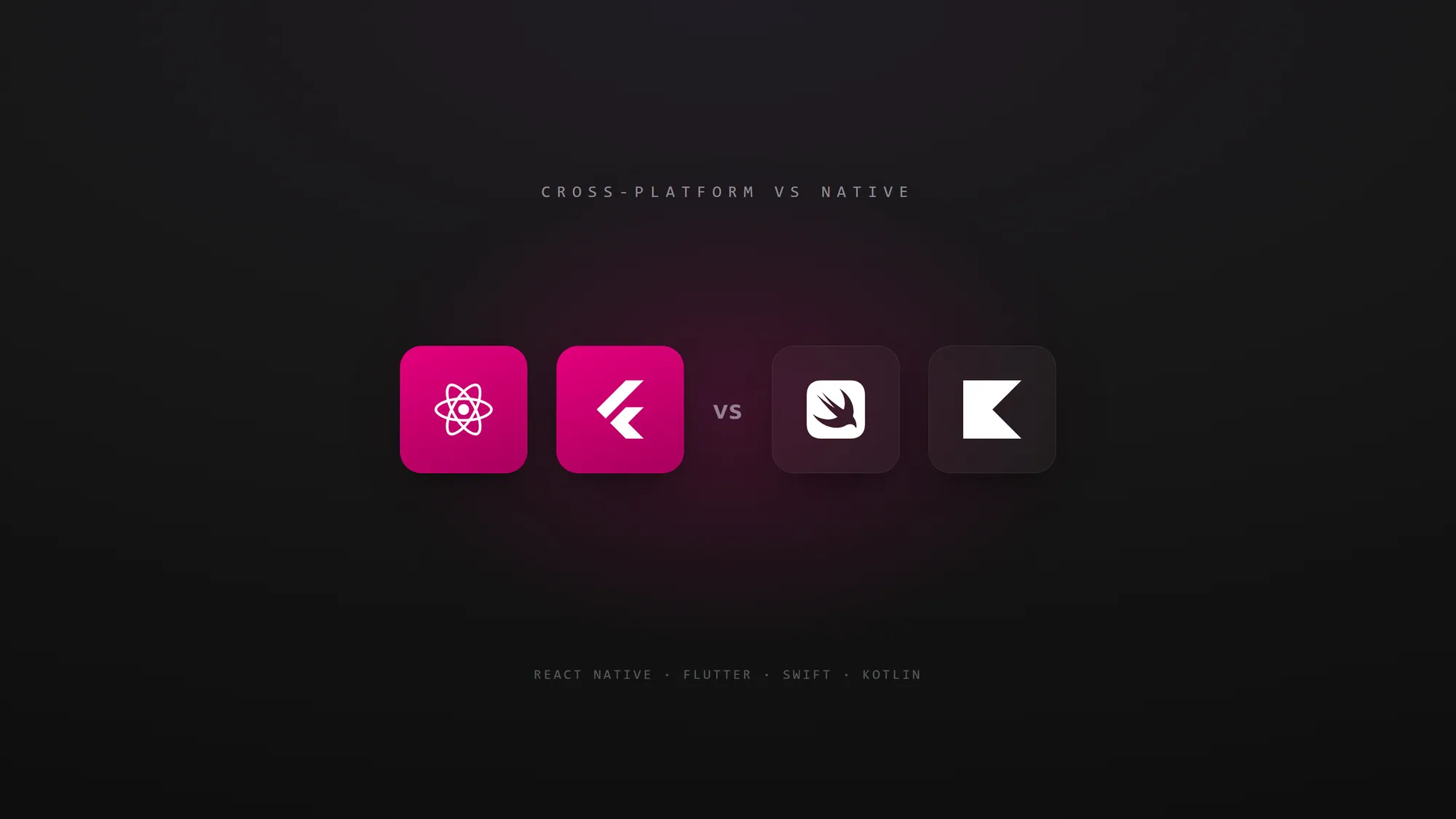
Native apps are built separately for each platform using its own tools — Swift or SwiftUI for iOS, Kotlin for Android. Two codebases, two builds. You get the best performance and the fullest access to device hardware, at the highest cost.
Cross-platform apps use one codebase — usually React Native or Flutter — that runs on both iOS and Android. You build once and ship to both stores, which is why this approach covers the needs of most business apps at roughly half the cost of two native builds.
Progressive web apps (PWAs) run in the browser but behave like an app — they can be installed to the home screen and work offline. No app store required. They're the lightest-weight option, best when broad reach matters more than deep device features or store presence.
Native vs cross-platform vs PWA at a glance
| Native | Cross-platform | PWA | |
|---|---|---|---|
| Performance | Best | Near-native | Good |
| Cost | Highest — two builds | ~Half of native | Lowest |
| Time to market | Slowest | Fast — one codebase | Fastest |
| Device hardware access | Full | Most | Limited |
| App-store presence | Yes | Yes | No (browser-based) |
| Best for | Heavy graphics, peak performance | Most business apps | Reach without app stores |
For a deeper side-by-side on the two app-store options, see cross-platform vs native. For most companies, cross-platform is the default that wins on cost and timeline without giving up much. Native earns its premium when you lean hard on the device — games, AR, heavy real-time graphics, or anything where every frame counts.
The app development process, step by step
Whatever type you pick, the work moves through the same six stages. Skipping one doesn't make a project faster — it just moves the cost to later, when it's more expensive to fix.
- Discovery — define the problem, the users, and the scope of version one. This is where a clear build is separated from a vague one, and where most overruns are prevented.
- Design — map the user flows, then the screens. Good mobile design makes the core task obvious in two taps instead of five; UX flows come first, UI polish second.
- Build — the engineering: the app itself, the backend that powers it, and the integrations (payments, maps, auth, notifications). This is the largest stage by effort.
- Test — on real iOS and Android devices, not just a simulator. The bugs that matter usually only appear on actual hardware across varying screens and OS versions.
- Launch — submit to the App Store and Google Play, clear review, and ship. Each store has its own rules and timelines, so launching is its own stage.
- Maintain — this never ends while the app is live. New OS versions ship yearly and users find edge cases. An app is a product you keep, not a project you finish.
If you want the full walkthrough with the decisions inside each stage, we've written it up in how to build a mobile app.
What drives cost and timeline
There's no honest fixed price for "a mobile app," because the number is set by scope. Four factors move it the most:
- Platform count. One platform or both? Cross-platform keeps this to a single codebase; two native builds roughly double the work.
- Features and screens. Every feature is design, build, test, and maintenance — not a one-time cost. A lean version-one ships far faster than a kitchen-sink release.
- Backend and integrations. A standalone app is cheap. One that syncs data, processes payments, and talks to third-party systems carries real engineering weight.
- Design complexity. A clean, standard interface is quick. Custom animation, bespoke components, and brand-heavy UI add time.
The single largest lever on both cost and timeline is the type decision above. Choosing cross-platform over two native builds is what takes a project from two codebases to one — and it's why a focused first version can ship in a few months rather than dragging on.
How to choose a development partner
Most app advice stops at "pick a good team," which isn't advice. Here's what actually separates a build that lasts from one you rewrite in eighteen months.
Look for built-to-last engineering, not a demo. Plenty of teams can produce something that looks finished in a pitch. The hard part shows up in stage six: clean architecture, real test coverage, and code the next developer can read. Ask how they handle OS updates and maintenance, not just how fast they can ship version one.
Weigh the cost structure honestly. Onshore agencies are expensive; pure offshore can mean timezone gaps and rework. The nearshore middle — nearshore software development from Mexico — overlaps US working hours and lands at a fraction of US agency rates, which is the model behind our mobile app development service. Pair that with cross-platform, and you're building one codebase for both stores, with a team in your timezone, at roughly half the cost.
Make sure the scope is real. A good partner pushes back on scope in discovery, ships a focused version one, and plans for the maintain stage from day one — not one who agrees to everything and discovers the hard parts in week three.
The bottom line
Mobile app development is the full path from idea to a maintained product running on real phones — discover, design, build, test, launch, maintain. The two decisions that shape everything are the type of app (native for peak performance, cross-platform for most business cases, PWA for browser reach) and the partner you build with. For most companies, the answer that holds up is cross-platform, built nearshore, scoped tight, and engineered to last past launch — an app you keep, not one you replace.