

















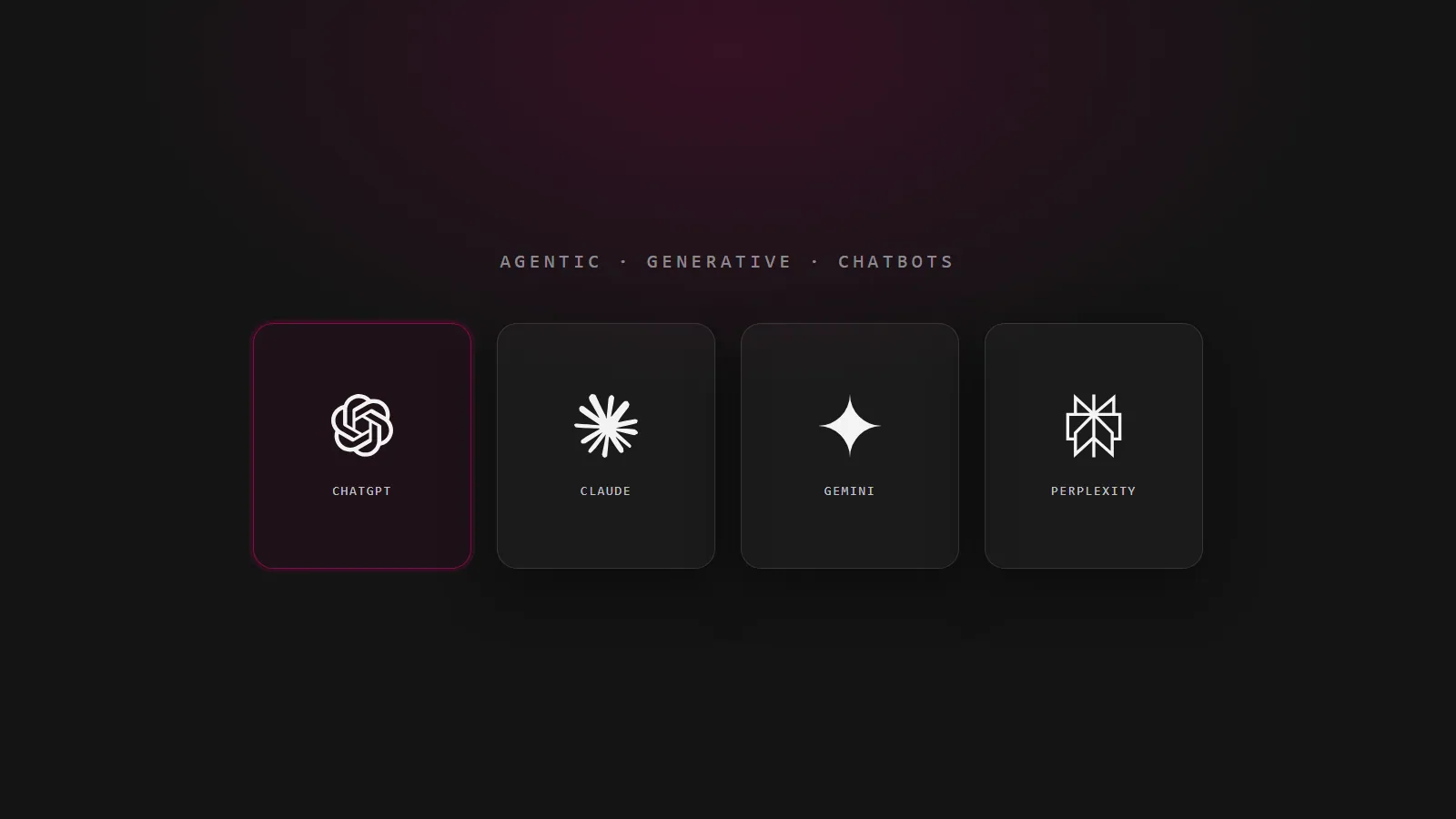
Agentic AI, generative AI, and chatbots are three different things people keep mixing up. A chatbot answers a question and waits. Generative AI creates content — text, code, images — from a prompt, then stops. Agentic AI acts: it uses a generative core plus goals, tools, and a loop to plan and complete a multi-step task on its own.
That progression — answer, create, act — is the whole story. Each layer adds one capability to the one before it, and the cost, risk, and payoff climb with it.
Agentic AI vs generative AI vs chatbots at a glance
The fastest way to see the difference is to line them up. Notice how each model keeps the abilities of the one before it and adds something new:
Chatbot
- Core job: answer or deflect
- Output: a reply
- Reactive — waits for you
- Rarely uses external tools
- No multi-step work
- Best for FAQs and routing
Generative AI
- Core job: create content
- Output: a draft or artifact
- Reactive — one prompt, one output
- Doesn't use external tools
- No multi-step work
- Best for drafting and summarizing
Agentic AI
- Core job: achieve a goal
- Output: a completed outcome
- Proactive — plans and acts
- Uses APIs, systems, and data
- Loops until the job is done
- Best for end-to-end processes
The pattern: a chatbot talks, generative AI produces, and agentic AI does. Most people's "AI" mental model is still stuck on the first two columns.
What is a chatbot?
A chatbot is the oldest of the three. Classic chatbots run on scripted flows and decision trees — "press 1 for billing." Newer ones bolt a language model onto that front end so the conversation feels natural. Either way, a chatbot is reactive: it responds to one message at a time and then waits for you. It doesn't pursue a goal or take action in other systems on its own.
That makes chatbots great for FAQ deflection, lead capture, and routing — and a poor fit the moment a task needs more than a single back-and-forth.
What is generative AI?
Generative AI is the model layer most people met through tools like ChatGPT. Give it a prompt and it generates something new — an email, a block of code, a summary, an image. It's powerful and flexible, but it's still a one-shot transaction: prompt in, content out, full stop. It has no goal of its own and takes no action beyond producing the artifact you asked for.
Generative AI is the engine. On its own, it drafts; it doesn't drive.
What is agentic AI?
Agentic AI is generative AI with agency — goals, memory, tools, and a loop. An AI agent takes an objective ("reconcile these invoices," "resolve this support ticket"), breaks it into steps, calls the tools and systems it needs, checks its own progress, and keeps going until the goal is met. The generative model is still in there, but now it's the reasoning core of a system that can act, not just answer.
This is the leap that makes people ask whether agentic AI is "just generative AI with extra steps." It is — and those extra steps (planning, tool use, looping) are exactly what turn an answer into an outcome. Building that wrapper safely is a discipline of its own, which is the work behind our AI agent development service.
How they fit together
These aren't competitors — they stack. In a real US deployment you'll often see all three at once: a chatbot as the conversational front door, a generative model as the reasoning core, and an agent doing the multi-step work behind the scenes — pulling data, calling APIs, and only pausing when it needs a human to approve a key step.
So the real question isn't "agentic AI vs generative AI" as a winner-take-all fight. It's which layer your task actually needs.
AI agents vs automation vs LLMs
Two more comparisons come up constantly, because they're the things agents get confused with most:
| Traditional automation | LLM (on its own) | AI agent | |
|---|---|---|---|
| How it decides | Fixed rules you wrote | Generates text from a prompt | Reasons and chooses its own steps |
| Handles the unexpected | Breaks on any edge case | Answers, but can't act | Adapts, retries, calls tools |
| Takes real actions | Only the ones scripted | None — it just outputs | Yes — across your systems |
AI agents vs automation: classic automation (RPA, Zapier-style flows, scripts) runs a path you defined in advance and breaks the moment reality drifts from the script. An agent decides the path at runtime, so it absorbs variation a rules engine can't. Use automation when the steps never change; use an agent when judgment is required between them.
AI agents vs LLMs: an LLM is the reasoning core — give it a prompt, get text back. An agent wraps that LLM in goals, memory, and tools so it can act on what it reasons. Put simply, the LLM is the brain; the agent is the brain plus the hands.
Which one does your task need?
- Use a chatbot when the job is answering known questions or routing people — support FAQs, simple lead capture, deflection.
- Use generative AI when you need content created and a human will review it — drafting, summarizing, first-pass code, marketing copy.
- Use agentic AI when you need a multi-step process executed, not just assisted — order-to-cash workflows, ticket resolution, research-and-act loops.
The cost curve follows the capability curve. A rules-based chatbot is cheap to stand up. Custom agentic AI is a real build: small-to-mid agent projects typically start around $25K, and complex enterprise deployments can pass $500K. The difference is the integration, guardrails, and testing an agent needs before it's allowed to act on your systems.
Why agents fail (and how to avoid it)
The reason "agentic AI" gets hyped and then disappoints is that demos hide the hard parts. In production, agents fail when tool handoffs break, authentication isn't handled, the system hallucinates without guardrails, or it needs constant babysitting to stay on track. None of that shows up in a slick demo — it shows up in week three. Shipping an agent that holds up means real engineering around the model: error handling, monitoring, and human checkpoints at the steps that matter.
The bottom line
Don't ask which of agentic AI vs generative AI vs chatbots is "best" — they solve different problems. A chatbot answers, generative AI creates, and agentic AI acts, each building on the last. Pick the lowest layer that actually does your job: most teams need a chatbot or generative AI for routine work, and agentic AI for the multi-step processes where an outcome — not just an answer — is the point.