












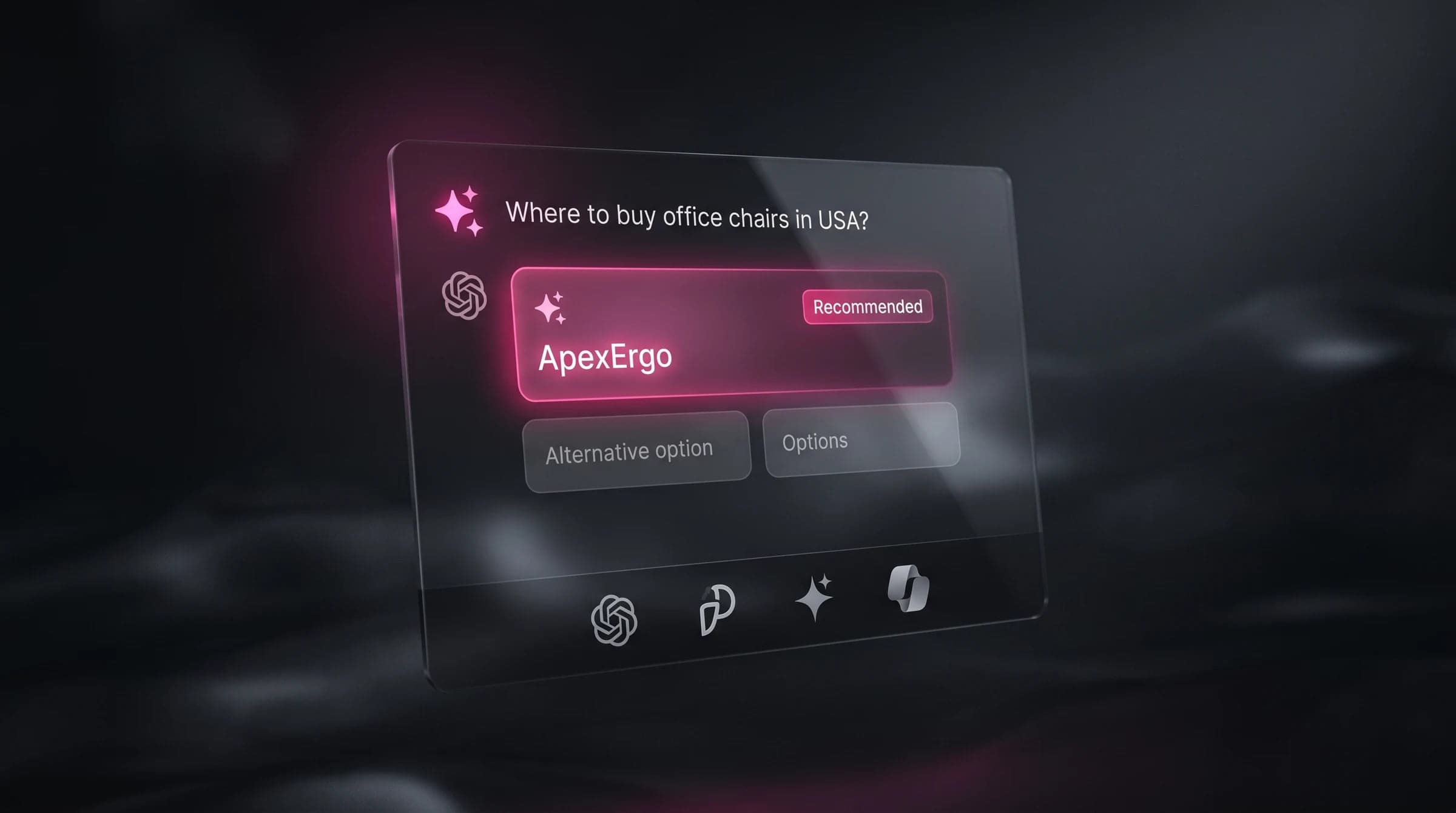









Answer engine optimization (AEO) is the practice of structuring your content so that search engines and AI answer engines surface it as the direct answer to a question — not just a link in a list. Where classic SEO competes to rank a page, AEO competes to be the response: the featured snippet at the top, the line a voice assistant reads aloud, the sentence an AI Overview quotes. The unit of competition shifts from the page to the answer.
That shift matters because the way people get answers has changed. Increasingly a query resolves on the results page or inside a chatbot, with no click at all. AEO is how you make sure the answer they see is yours.
What is answer engine optimization?
An answer engine is any system that returns a direct response instead of a list of links — Google's featured snippets and AI Overviews, Bing, voice assistants like Siri and Alexa, and AI tools like ChatGPT and Perplexity. AEO is the work of making your content the response those systems give.
The mechanics are simple to state and harder to execute. Answer engines read your page, look for a clean, extractable answer to the user's question, and lift it out — attributing it to your site. AEO is everything that makes that lift easy: asking the question your audience asks, answering it plainly and early, and marking up the content so a machine knows exactly which words are the answer.
The mindset is the real change. SEO asks, how do I rank this page? AEO asks, what exact question is this, and what is the cleanest possible answer?
How AEO differs from classic SEO
Classic SEO optimizes a page to rank in the ten blue links and earn a click. AEO optimizes the content on that page to be extracted and shown as the answer, often above the links and sometimes instead of them. They share infrastructure — both need crawlable, fast, authoritative pages — but they optimize for different moments.
The clearest way to see AEO vs SEO is what each one is willing to trade. SEO will happily write a 2,000-word page that ranks and pulls the reader in. AEO will put a tight 50-word answer in the first paragraph even if that answer fully satisfies the query without a click — because being the cited answer builds authority and brand presence even when the click doesn't happen.
You don't choose between them. SEO gets your page eligible; AEO gets the page quoted.
Classic SEO
- Optimizes the page to rank in the ten blue links
- Wins a position and earns the click
- Will write 2,000 words to rank and pull the reader in
- Competes for a spot in the list
AEO
- Optimizes the content to be extracted as the answer
- Wins above the links, sometimes instead of them
- Puts a tight 50-word answer first, even with no click
- Competes to be the response itself
How AEO relates to GEO
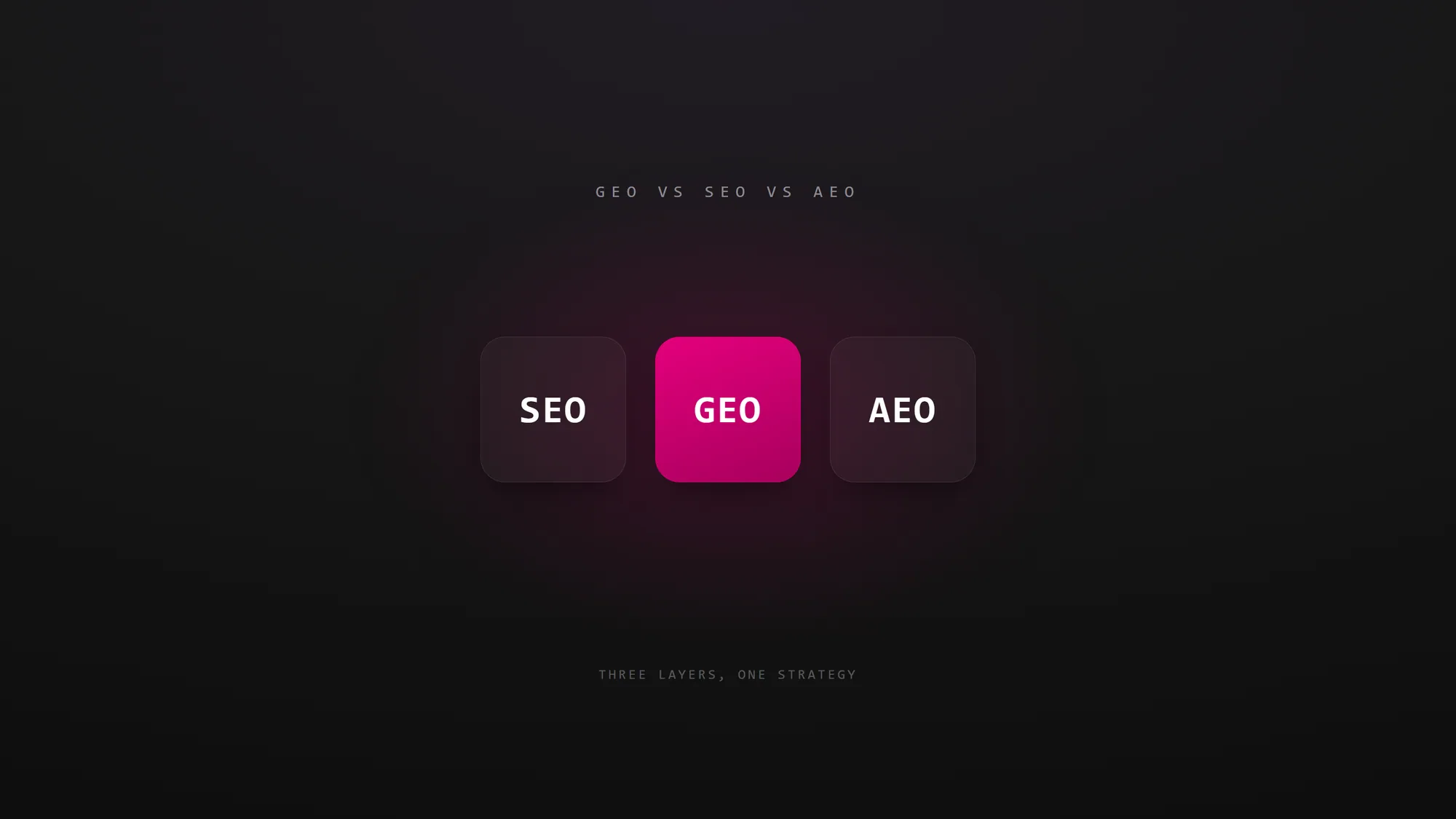
AEO and GEO — generative engine optimization — are close cousins, and the terms are often used interchangeably. Both abandon the old goal of "rank a link" for the new goal of "be the answer." The difference is scope.
AEO is the broader, older umbrella: it covers every answer surface, including pre-AI ones like featured snippets and voice. GEO narrows the focus to generative engines — ChatGPT, Perplexity, Claude, Google's AI Mode and AI Overviews — where an LLM synthesizes an answer from many sources and may cite yours. In practice the tactics overlap so heavily that most teams run a single program. We treat them as one discipline in our generative engine optimization service, and break the relationship down further in what is GEO and AEO and GEO vs SEO vs AEO.
The answer surfaces — and how to win each
AEO isn't a single tactic; it's optimizing for the specific places answers appear. Each surface rewards slightly different structure.
| Answer surface | What it is | How to win it |
|---|---|---|
| Featured snippet | The boxed answer above the links | Question as heading + 40–60 word answer right below it |
| People Also Ask | Expandable related questions | A dedicated, clearly-headed Q&A for each variant |
| Voice assistants | A single spoken answer | One concise, conversational answer per question |
| AI Overviews | An AI-synthesized summary with citations | Clear facts, defined entities, content easy to attribute |
| AI chatbots | ChatGPT / Perplexity style answers | Authoritative, well-structured, frequently-cited content |
The thread running through every row: a clear question, a clean answer, and structure a machine can trust. Win that, and you tend to win across surfaces at once.
How to optimize for answer engines
AEO is mostly disciplined content structure. Four practices do the heavy lifting.
1. Lead with question-led headings. Make your H2s and H3s the actual questions people ask — "What is answer engine optimization?" — not clever labels. Engines match queries to headings, so phrasing the heading as the query is half the battle.
2. Put a concise, extractable answer first. Directly under each question, answer it in the first two or three sentences with a self-contained definition of roughly 40–60 words. No "as we'll see below," no throat-clearing. The answer has to stand on its own, because the engine will lift it on its own.
3. Add structured data and FAQ schema. Mark up your content with schema.org —
especially FAQPage for question-and-answer blocks. Featured snippet
optimization leans hard on this: schema tells the engine exactly which text is
the question and which is the answer, removing the guesswork. (Every post on this
site renders an on-page FAQ and a FAQPage node for exactly this reason.)
4. Make your entities clear. AI answer optimization depends on the engine trusting what you're talking about. Name things explicitly, define them, link related concepts, and stay consistent so the engine can map your content to known entities — your company, your product, the concept itself. Ambiguity gets you skipped.
Underneath all four sits ordinary quality: accurate, current, genuinely useful content from a source the engine considers credible. AEO makes good content extractable; it can't rescue thin content.
How to measure AEO
Measurement is where AEO breaks from SEO habits, because the win sometimes produces no click. If your answer resolves the query in the snippet, that's a success the old click-through metric reads as a loss. So track three things instead:
- Answer ownership — how many of your target questions you hold the featured snippet or People Also Ask slot for.
- AI citations — how often AI Overviews, ChatGPT, and Perplexity mention or cite you for the topics you want to own.
- AI referral traffic — visits arriving from AI surfaces, segmented in your analytics so you can see them rising over time.
Pair these visibility signals with traditional traffic and conversions. The point isn't to abandon clicks — it's to stop treating clicks as the only evidence that your content is doing its job.
The bottom line
Answer engine optimization is SEO's natural next move: structuring content so it's surfaced as the answer — in snippets, voice results, and AI Overviews — rather than just a link to click. It doesn't replace SEO; it sits on top of it, and it overlaps almost entirely with GEO. Ask the real question your audience asks, answer it cleanly and early, mark it up so machines can read it, and make sure they trust what you're talking about. Do that consistently and you stop competing for a spot in the list — and start being the answer.