




















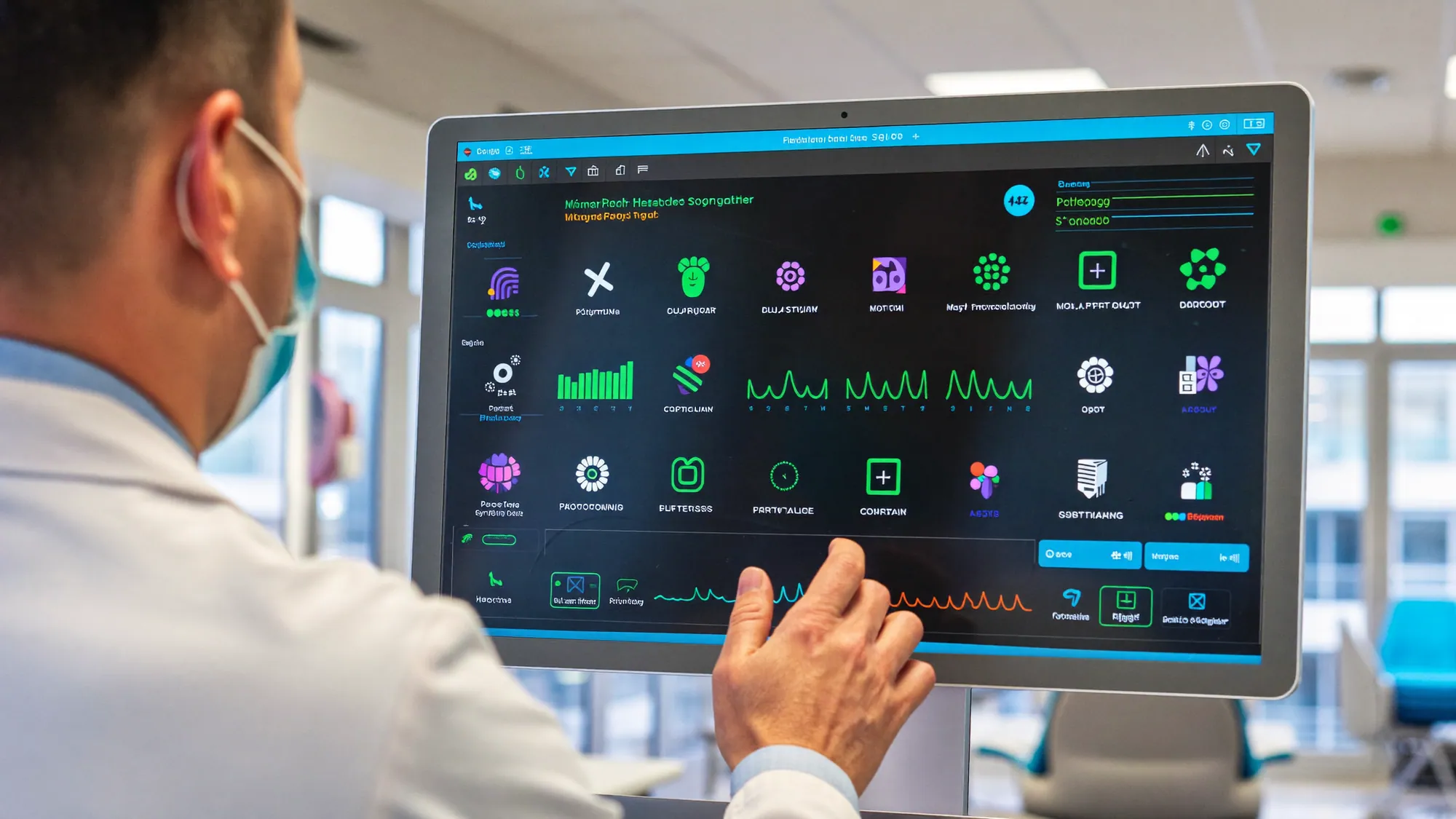
Custom healthcare software development is the practice of building software tailored to a specific provider, payer, or health-tech company — EHR/EMR systems, patient portals, telehealth platforms, and clinical workflow tools — instead of buying off-the-shelf. Because it handles protected health information, it's built HIPAA-aware from the first line of code.
That last part is the whole difference. In most industries, custom software is about fit. In healthcare, it's about fit and compliance — and the teams that treat HIPAA as an afterthought are the ones that end up rebuilding. The same discipline applies to custom medical software development — device-adjacent tools, clinical decision support, and practice systems — where regulatory rigor and clinical workflow matter just as much as in provider or payer software.
What is custom healthcare software?
Custom healthcare software is built for your organization's workflows rather than the average buyer the vendor had in mind. It spans the systems clinical and operational teams rely on every day:
- EHR / EMR systems and modules that fit how your clinicians actually chart
- Patient portals for scheduling, results, messaging, and intake
- Telehealth platforms with secure video, e-prescribing, and notes
- Clinical and operational tools — care coordination, billing, analytics
- Integrations to the systems you already run via HL7 and FHIR
It's the same custom build discipline we apply across our custom software development practice — discovery, design, build, deliver, evolve — with healthcare's compliance and interoperability requirements layered in from the start.
Custom vs off-the-shelf healthcare software
Off-the-shelf products ship fast but bend your workflows to their model. Custom software bends to you — at a higher upfront cost. The honest comparison:
Off-the-shelf product
- You adapt to the vendor's model
- Integrations limited to supported connectors
- You license it; the vendor owns it
- HIPAA approach depends on the vendor's posture
- Lower upfront cost
- Long-term fit capped by a roadmap you don't control
Custom healthcare software
- Shaped to your exact clinical workflow
- Built for the systems you run (HL7/FHIR)
- You own the code and IP
- HIPAA designed in from day one
- Higher upfront cost
- Grows with you over the long term
The rule of thumb: buy when your needs are generic, build when the workflow is your advantage — which, in most provider and health-tech orgs, it is.
Building HIPAA-aware from day one

HIPAA compliance isn't a feature you bolt on before launch — it's a property of how the system is designed and operated. For any software that touches protected health information (PHI), the non-negotiables are:
- Access controls — role-based access, least privilege, unique user IDs
- Encryption — PHI encrypted in transit and at rest
- Audit logging — a tamper-evident record of who touched what, when
- A Business Associate Agreement (BAA) — signed with every party that handles PHI on your behalf, including your development partner
- Compliant infrastructure — PHI hosted in HIPAA-eligible US cloud services
Design for these from the first sprint and they cost a fraction of what they cost as a retrofit. That's the single most expensive mistake in healthcare builds — and the easiest to avoid.
How much does custom healthcare software cost?
There's no flat price, because scope is the cost. A focused telehealth or patient-portal MVP is far cheaper than a full EHR wired into multiple hospital networks. The real cost drivers are the number of distinct workflows, the integrations (HL7/FHIR, labs, billing, e-prescribing), and the security and compliance work HIPAA requires. A nearshore team in Mexico typically lowers the all-in cost versus US onshore rates while keeping the real-time collaboration that compliance-heavy work depends on.
Why nearshore for healthcare builds
Healthcare software is exactly the kind of work where time-zone overlap pays off. Compliance reviews, clinical-workflow decisions, and security questions can't sit in an async queue for a day — they need a live conversation. A nearshore partner can sign the BAA, follow HIPAA's technical safeguards, host PHI in compliant US cloud infrastructure, and do it all on your business hours.
From Monterrey — roughly 140 miles from the US border — a senior team works the same day you do, joins the same calls, and ships with the same urgency as an in-house group. The engineers' location doesn't determine compliance; the controls, contracts, and architecture do.
Choosing a custom healthcare software development company
The right custom healthcare software development company is one that treats HIPAA and interoperability as table stakes, not add-ons. When you compare custom healthcare software development services, look for a signed BAA, prior HL7/FHIR work, senior engineers with healthcare context, and clear IP ownership in your name. Healthcare data and analytics often ride alongside these builds — see healthcare data analytics for the reporting layer, and digital transformation in healthcare for how a custom build fits a broader modernization roadmap.
The bottom line
Custom healthcare software wins when your workflow is your advantage and an off-the-shelf product would force you to compromise it. Build it HIPAA-aware from day one — access controls, encryption, audit logs, and a signed BAA are cheaper designed in than retrofitted. And for compliance-heavy work where decisions can't wait, a nearshore team gives you US-hours collaboration, a US client's time zone, and lower total cost — without sending PHI to the other side of the world.